Data Centers in Space: The Physics That Will Decide If AI Moves to Orbit
An Nvidia H100 has trained a small model in orbit. Between that demonstration and a space data center lie unresolved problems in heat, communications, reliability and economics.
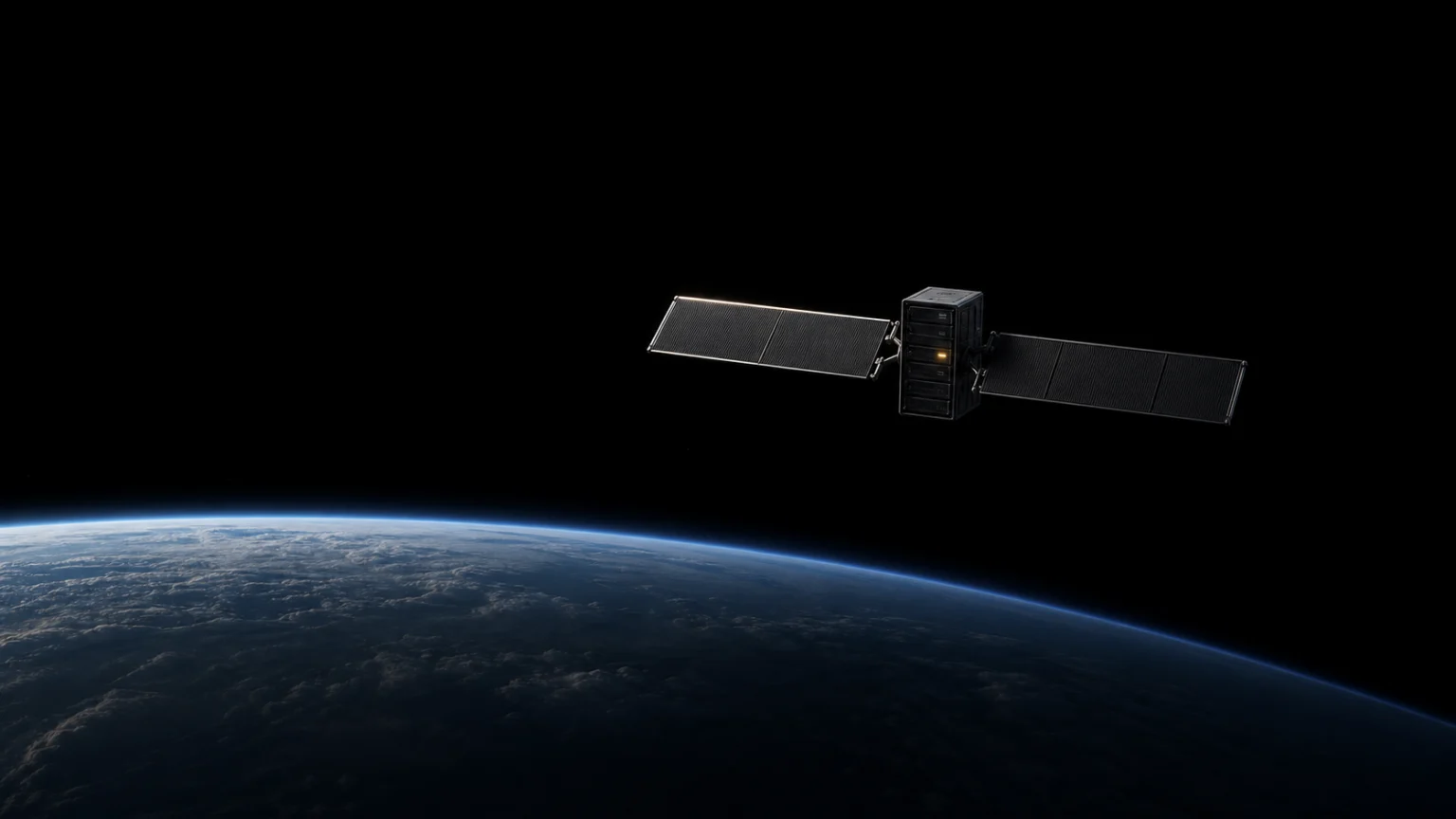
An Nvidia H100 is aboard Starcloud-1, a satellite the company says launched in November 2025. In December, according to Starcloud, it ran a version of Gemma and trained the small nanoGPT, which it presents as the first language model trained on a spacecraft. The page documents the demonstration and month, not an exact launch day or orbital speed.
So the question is no longer whether you can put an AI chip in space. You can: it's done and it's running. The question — far harder and far more interesting — is whether it makes sense to send up not a chip, but an entire data center, with its thousands of processors, its electric hunger, and its heat. And that answer is decided, before any visionary and before any investor, by physics. This is an attempt to tell, honestly and without smoke, what is already known, what is in doubt, and what remains unsolved.
The problem starts on the ground
To understand why the industry is looking up, start with terrestrial demand for electricity, land, cooling, and grid connections. The primary sources cited in this analysis describe the orbital proposal; they do not measure worldwide data-centre consumption or U.S. demand. The physical argument can be examined without presenting projections of uncertain origin as facts.
A gigawatt is, roughly, the consumption of a mid-sized city. Multiply that by dozens, and add that the demand concentrates in a few counties whose grids were never designed for such a bite. The consequences are already visible: saturated substations, projects waiting years for a connection, and a growing local backlash against megacenters that compete for water and push up the price of power. AI is running into a limit that isn't about cleverness, but about earthbound infrastructure. And when a resource runs dry in one place, industry does what it has always done: look for it somewhere else. In this case, somewhere else is four hundred kilometers up.
Why space tempts the AI industry
The logic is seductive and, in part, old. The idea of harvesting solar energy in space dates back to the 1970s, when physicist Gerard O'Neill and NASA dreamed of enormous orbital panels beaming electricity down to Earth. That never left the page, because there was no demand to justify the cost. AI has just supplied that demand.
An Earth data center competes for power, cooling, and land. In the dawn–dusk sun-synchronous orbit proposed by Project Suncatcher, Google calculates that a panel can be up to eight times more productive than on Earth and receive nearly continuous light. “Nearly” matters: orbit, attitude, eclipses, degradation, structure, and power conversion remain part of the system.
Orbit needs no evaporative tower to reject heat into air, but heat does not vanish. It must travel from the chip through a thermal system and leave as infrared radiation. The linked sources do not quantify a 700-watt load or “millions of litres” saved for this system; transferring those figures requires comparable equipment, workload and cooling. Calling vacuum an “infinite heat sink” hides the decisive component: how much power a finite surface can radiate at operating temperature.
Who is already building
Starcloud did more than train a small model: it also reports running Gemma in orbit on the H100. That shows one unit operated during those tests, not that “consumer hardware”—the H100 is a data-centre accelerator—survives years of radiation or that a cluster is maintainable. The linked official page does not document a $170 million funding round or say its next radiator will be the largest deployed by a private spacecraft.
Google proposes a constellation carrying TPUs linked optically. To approach terrestrial data-center behavior, its analysis requires tens of terabits per second between spacecraft and very close formations, kilometers or less, because received power falls with distance squared. Two prototypes with Planet were planned for early 2027; they were a learning mission, not a data-center deployment.
Google also tested Trillium TPUs against cumulative radiation dose. High-bandwidth memory began showing irregularities at 2 krad(Si), versus an estimated shielded five-year dose of 750 rad(Si), and the company attributed no hard failures to total dose up to the tested maximum of 15 krad(Si) on one chip. This is promising, but a laboratory total-dose test does not reproduce every particle event, thermal cycle, or unit-to-unit variation in service.
The wall no one has torn down yet
This is where honest science writing has to part ways with the hype, because the greatest enemy of this idea isn't radiation or cost: it's heat, and it's pure high-school physics. Space is an infinite heat sink, true, but with an essential catch: in the vacuum there is no air. And without air, heat cannot be carried away by convection — the way your computer's fan or a data center's air conditioning expels it. In the vacuum, the only way to shed heat is to radiate it, to emit it as infrared light into the blackness.
Radiated power grows with area, emissivity, and the fourth power of absolute temperature. This forces designers to size surfaces, thermal transport, orientation, and degradation for a particular load. A NASA technical study of orbital radiators already treated geometry, dissipated load, attitude, environment, and ageing as coupled constraints. Without temperature, emissivity and design, neither “football fields” nor 700 watts constitutes a reproducible thermal calculation.
And then there's the rocket's bill
The second wall is economic. Google's analysis projects that, under a sustained learning rate, launch price could fall below $200 per kilogram by the mid-2030s; at that point, launch and operation might become comparable with reported terrestrial energy cost per kilowatt-year. This is a condition in its model, not an observed price or certain forecast. The paper does not state today's cost, the mass of a complete data centre, the number of launches or dependence on a particular rocket.
More unknowns remain, and they deserve to be stated plainly rather than hidden beneath the shine of a headline. No one knows how to repair a failed server four hundred kilometers up, where no hand and no technician reaches: on Earth, a failed chip is swapped in minutes; in orbit it is, for now, unrecoverable scrap that also feeds the space-junk problem. No one knows for certain how those processors age after years of real radiation and extreme thermal cycling, rather than an afternoon in a particle accelerator. And it is not proven that, adding launch, cooling, maintenance, and replacement, the final math favors space over the more boring and more likely alternative: a sunny desert covered in panels and batteries.
Latency decides who goes up and who stays
There's a technical nuance often lost in the debate that will probably mark the real boundary. Not all AI tasks are equal. Training a model — the slow, massive process of teaching it from trillions of data points — doesn't need an instant answer: it can take weeks, and no one minds if the data travels a few milliseconds farther. It's the ideal load to send where the Sun never sets. Inference, on the other hand — every time you ask an assistant something and wait for the reply — lives or dies by latency: no one wants their question to fly up to orbit and back before it's answered. That boundary, between what tolerates distance and what doesn't, is the one that will decide which part of AI might move and which will stay, forever, close to home.
So, is it the future or is it smoke?
It's both, depending on where you look, and being precise demands holding both at once. As a demonstration, it already happened: there is artificial intelligence training in orbit today, and just two years ago that sounded like a boast. As a replacement for Earth-bound data centers, it remains a hypothesis physics has not yet authorized and economics does not yet support; claiming otherwise would be selling a future no one has built.
A plausible outcome would be gradual: first, workloads able to tolerate intermittent links, latency, and reduced maintainability. Even that is undecided. Orbital solar energy is neither infinite nor free; it requires panels, conversion, structure, launch, and replacement. The leap from one H100 to infrastructure at scale depends on measured balances of power, mass, heat, communications, reliability, and cost. That is the useful test for the next promise: ask for the complete system, not only the chip that reached orbit.
This article was produced with artificial intelligence under human editorial oversight.