AGI geopolitics: the race depends on a global chain
Competition over advanced AI is not a league table of countries. It is a chain of chips, energy, data centres, talent, markets and rules in which power comes from controlling bottlenecks—and from cooperation.
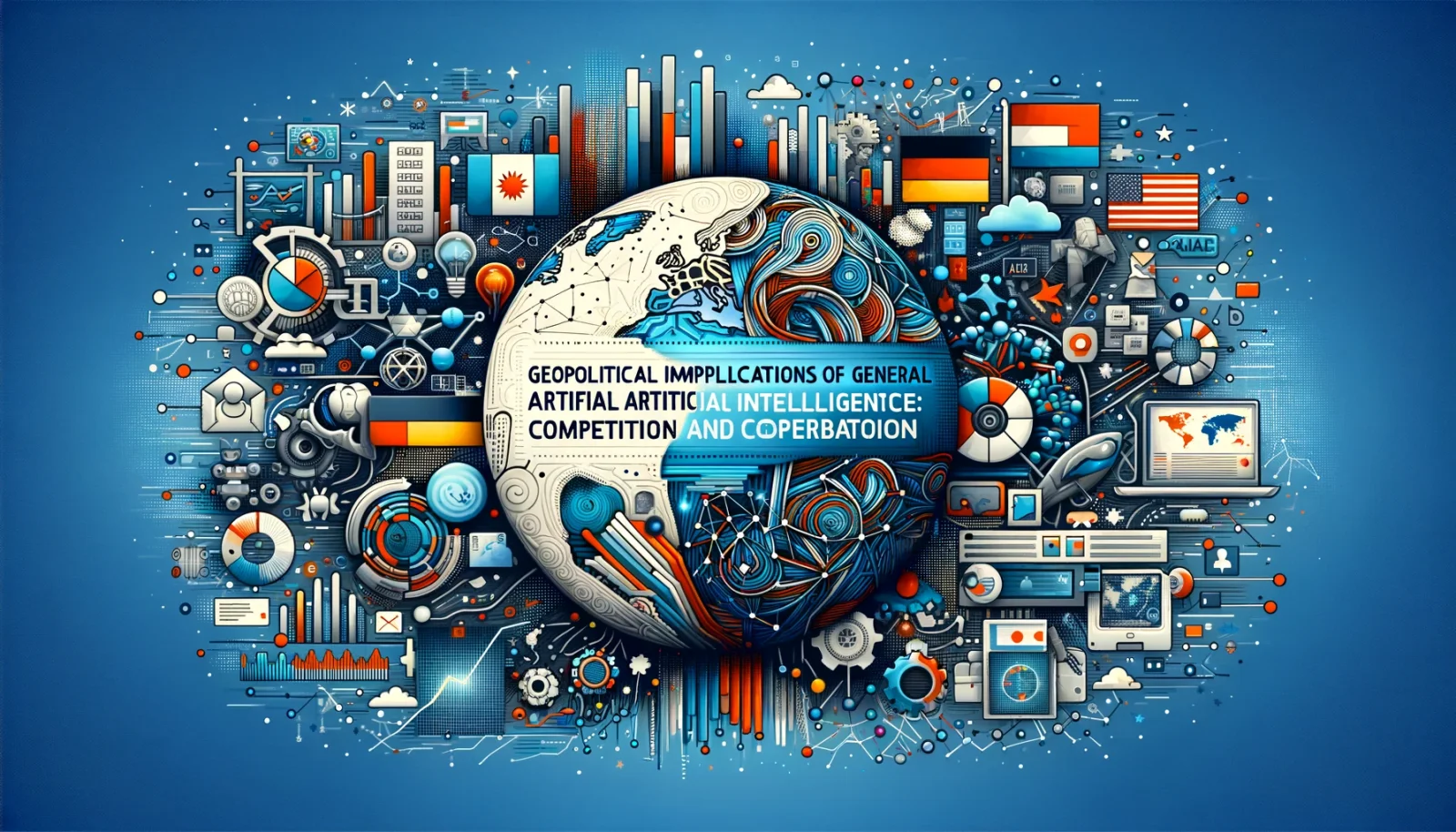
As of 30 July 2026, no one can point to a universally accepted test and declare that one country has “won AGI.” Geopolitical competition is nevertheless real: governments fund computing capacity, attach conditions to chip sales, attract data centres, write rules and negotiate how the most powerful models should be evaluated. They are not competing for a box called AGI, but for positions within a global infrastructure.
The language of a “race” conveys urgency, but it misleads when it suggests one track and one finish line. Advanced AI depends on a chain: chip design, manufacturing equipment, foundries, memory, packaging, networks, electricity, cooling, cloud services, data, talent, models and distribution. No country controls every link equally. The geopolitical question is not only who has the best model, but who controls a bottleneck, how long another actor would take to replace it and which costs that decision pushes onto the rest of the chain.
First replace the map of countries with a map of the stack
A claim that “country A leads country B in AI” combines different assets. One place may host companies that design accelerators; another may have foundries; another controls critical equipment; another supplies inexpensive energy; another has users and sectoral data. The advantage changes with the question. Training a frontier model, deploying millions of assistants, automating an industry and turning AI into military capacity do not require exactly the same mix.
A useful map divides the stack into four layers:
- Physical resources: semiconductors, memory, networks, data centres, energy, water and land.
- Technical capacity: talent, algorithms, software, security, evaluation and large-scale operations.
- Economic access: capital, cloud services, customers, industrial supply chains and markets where systems can be integrated.
- Institutional capacity: rules, public procurement, export controls, alliances and legitimacy to set standards.
Leadership in models may be fragile if it depends on imported components or a congested power grid. Conversely, control of a manufacturing technology does not automatically produce strong models or useful applications. The stack prevents a striking demonstration from being mistaken for durable power.
Chips reveal competition and interdependence at the same time
Advanced semiconductors are the most visible bottleneck. Their supply chain crosses borders and combines intellectual property, design software, manufacturing equipment, materials, foundries, high-bandwidth memory, packaging and servers. This interdependence enables cooperation, but also creates points at which a state can exert pressure.
US controls show that such pressure is not static. On 13 January 2026, the Bureau of Industry and Security announced that certain applications to export chips such as Nvidia’s H200 or AMD’s MI325X to China would be reviewed case by case under conditions covering security, availability to US customers and independent testing. This is not an eternal description of the regime; it is a dated snapshot. That is precisely why it reveals the mechanism. Controls can deny, authorise, license, require due diligence or change as technology and strategy evolve.
To assess their effect, it is not enough to read “banned” or “allowed.” Ask which exact product the rule covers, which destinations and uses it reaches, whether inventories or alternatives exist, how long substitution takes and whether the authority can monitor compliance. A restriction may slow access, stimulate alternative designs, shift demand to cloud services or impose costs on suppliers in the country that created it. The outcome is dynamic, not automatic.
Electricity turns digital geopolitics into physical geography
AI looks like software, but it runs in facilities that need grid connections, transformers, cooling and permits. The International Energy Agency’s Key Questions on Energy and AI, published on 16 April 2026, estimates that data-centre electricity consumption grew by 17% in 2025. It also describes tightening bottlenecks and an accelerating search for grid and supply solutions.
The figure does not mean all that electricity is used for AGI, or that the country with the most megawatts will lead. It means energy constrains the speed and location of deployment. Two regions with access to the same chips may differ in grid-connection times, electricity prices, reliability or local acceptance of new facilities. Computing power therefore becomes energy, industrial and territorial policy.
This layer also reveals who bears the costs. A data centre may bring investment and jobs while competing for grid capacity, water or land. A geopolitical assessment is incomplete if it counts accelerators but ignores the households, industries and communities sharing the infrastructure.
Models, applications and standards create different advantages
The most capable model does not capture all the value on its own. Companies and public bodies must integrate it into specific processes, data and lines of responsibility. A country with strong health, industrial or education networks may extract more value from a foreign model than another country with a domestic model but limited adoption capacity. It may also reduce dependence by using several providers, open models, public infrastructure or sector-specific expertise.
Rules create another form of power. A large market can demand documentation, evaluation or security and lead foreign providers to adopt those practices in order to sell there. The European Union’s obligations for general-purpose AI model providers, applicable since 2 August 2025, illustrate this effect: documentation for authorities and downstream integrators, a copyright policy and a summary of training content, with additional duties for models with systemic risk. This is regulatory power, distinct from the ability to manufacture chips or train models.
Why cooperation survives competition
The incentives to compete are strong: productivity, influence, revenue, intelligence, defence and the ability to set dependencies. Some risks, however, cross the same borders as supply chains. A cybersecurity failure, a dangerous capability distributed worldwide or an incident in a service used across several countries cannot be contained through a national ranking.
The Bletchley Declaration, agreed on 1 November 2023 by 28 countries and the European Union, including the United States and China, did not remove their disagreements. It did establish minimum common ground: frontier-AI risks can be international and require research, metrics, testing and cooperation. That process led to the effort now producing the International AI Safety Report 2026, written by more than one hundred experts with an advisory panel nominated by over thirty countries and international organisations.
Cooperation does not have to mean sharing models, chips or secrets. It can mean four narrower things:
- using comparable vocabularies and methods to measure capabilities and risks;
- reporting incidents that may propagate across countries and providers;
- maintaining crisis channels to reduce misinterpretation and escalation;
- broadening scientific and evaluation capacity so that safety does not depend on a handful of laboratories.
The UN General Assembly’s Resolution 78/265, adopted without a vote on 21 March 2024, adds a dimension that race metaphors often erase: closing digital divides within and between countries. If only a few states can train, evaluate or govern advanced systems, everyone else receives products and consequences without equivalent power to inspect them or negotiate their terms.
A card for reading any “AI race” announcement
Before accepting a geopolitical conclusion, answer five questions:
- Link: is the claim about chips, energy, talent, models, applications, markets or rules?
- Mechanism: does the measure fund, restrict, license, purchase, standardise or share information?
- Substitution: what alternative exists, and how much time, money and knowledge would it require?
- Horizon: is this an immediate edge, a ten-year industrial capacity or an undated prediction?
- Externality: which risk or cost crosses borders and still requires coordination?
The card changes the story. A new factory is not independence; a restriction is not isolation; a large model is not adoption; an agreement is not trust. Each move changes one part of a shared network.
The transferable skill is this: whenever a headline says who is “winning” AGI, identify the specific link, the mechanism of power, the time required for substitution and the externality that still demands cooperation. AI geopolitics does not offer competition and cooperation as opposites. It combines them because states rival one another inside a chain that none controls completely.
This article was produced with artificial intelligence under human editorial oversight.