A History of AI: A Timeline of Tests, Promises, and Limits
AI did not advance in a straight line toward AGI. This history reads each milestone through its task, representation, signal, test, and infrastructure.
This guide, revised on July 30, 2026, tells the history of artificial intelligence without drawing an inevitable arrow from automata to AGI. A mechanical figure repeating movements, a program applying rules, and a network learning from examples may look like chapters in one march. Technically, they answer different questions, use different resources, and demonstrate different capabilities.
History becomes useful when every milestone is read through five questions: What task was defined? How was knowledge represented? Where did the learning signal come from? Which test supported the claim? Which infrastructure made it possible? This template separates a durable innovation from a promise that changed vocabulary without changing evidence.
Automata are cultural prehistory, not early AI
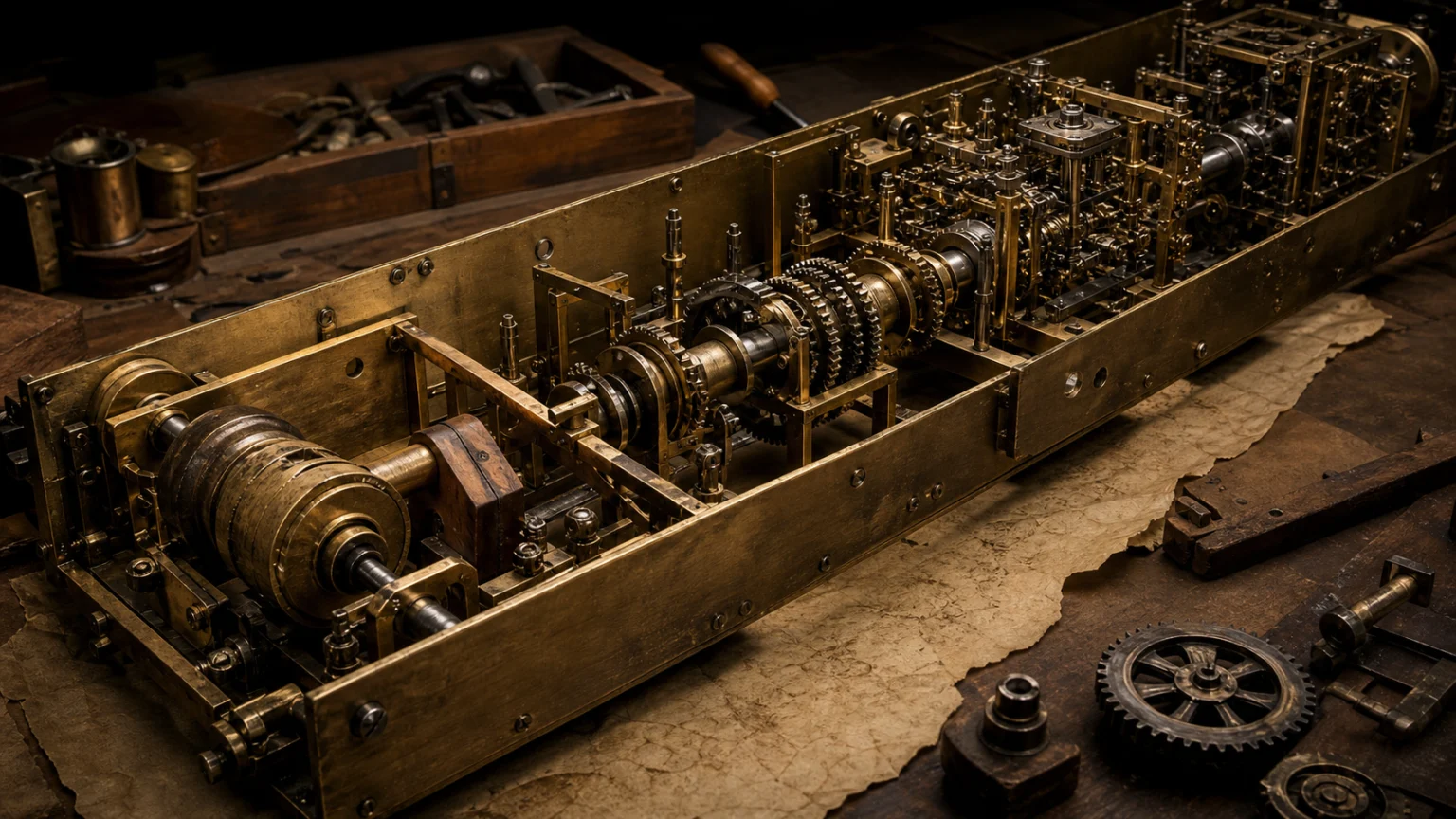
Clocks, mechanical figures, and machines programmed through cams or cards showed that an artifact could execute a complex sequence. Their apparent autonomy depended on a mechanism fixed by the builder: they inferred no new rule and did not adjust behavior from data. Their place in AI history is cultural and conceptual. They made artificial behavior visible, but they did not contain modern machine learning in miniature.
The distinction prevents an easy causal story. A chronology can connect inventions without claiming that one directly produced the next. The decisive shift for AI was not that a machine moved like a living creature, but that computation could be expressed generally, executed on electronic computers, and used to study behaviors called intelligent.
1950: replacing “thinking” with an observable test
In “Computing Machinery and Intelligence”, published in 1950, Alan Turing replaced “Can machines think?” with the imitation game. The historical intervention was not a declaration about the essence of intelligence, but a proposal for observable behavior in written conversation. The paper also discussed objections and considered a machine that could learn.
The test had both a virtue and a limit. It supported debate about performance without agreement on a metaphysical definition of thought, but it measures linguistic interaction under one protocol. Passing it would not demonstrate physical perception, general autonomy, or consciousness. The historical lesson is that fields progress by operationalizing questions, and an operation never exhausts the concept.
1955–1956: a name and a research program
The Dartmouth proposal, dated August 31, 1955, for a summer 1956 project, offered the conjecture that aspects of learning and intelligence could be described precisely enough for a machine to simulate them. It listed language, neural networks, abstraction, creativity, and self-improvement among its problems.
The document is a better source than the legend of an instantaneous “birth.” The gathering did not produce general intelligence; it assembled a name, researchers, and extraordinarily ambitious questions. It also shows that tension between symbols and networks, or between built-in knowledge and learning, did not begin with today’s models. It was present in the program from the start.
The symbolic era: making rules and searches explicit
One major early tradition represented facts, goals, and rules as manipulable symbols. Proving a theorem, searching for moves, or recommending an action could be framed as state-space search and inference. In “Programs with Common Sense”, John McCarthy proposed a system that could deduce immediate consequences from what it was told and what it already knew. The ambition was general, although working systems tended to bound their domains.
Expert systems show both the power and perimeter. MYCIN organized medical knowledge through rules and could explain which rules it was considering; the MYCIN project book documents its experiments and engineering. The milestone does not justify saying that “AI already diagnosed like a general mind.” It shows that representing specialized knowledge can produce competent behavior and that acquiring, maintaining, and situating those rules is part of the problem.
AI “winters” were institutional corrections
Popular history alternates between springs of enthusiasm and winters of disappointment. The label summarizes funding cuts, technical limits, and unmet expectations, but it does not mean that all research stopped. The report commissioned from James Lighthill by Britain’s Science Research Council in 1973, preserved in the UCL archive, belongs to this history of public evaluation and controversy.
Reading a winter requires asking which promise failed, which metric was absent, and which resources were insufficient. Sometimes an algorithm existed without enough compute or data; sometimes a small demonstration did not scale. A funding decline does not prove an idea false, just as later investment does not prove it correct. Technical and institutional histories intersect without being equivalent.
Neural networks: learning representations from error
Connectionism did not suddenly appear in the 2010s. Neural networks went through their own cycles and regained strength when methods, data, and hardware aligned. The 1986 paper “Learning representations by back-propagating errors” described repeatedly adjusting connections to reduce the difference between actual and desired output so internal units captured regularities of the task.
The historical difference from a fully hand-authored system concerns the source of representation: many features are adjusted from examples and a loss function. This does not remove human choices. Architecture, data, objective, and evaluation are still designed. “Learns by itself” erases precisely the decisions needed to explain what was learned.
Benchmarks and data become infrastructure
Modern progress cannot be narrated as architectures alone. ImageNet, presented in 2009 as a large-scale hierarchical image database, provided shared data and a benchmark for visual recognition. In 2012, the work known as AlexNet trained a deep convolutional network on the competition and showed a major improvement within that protocol.
The milestone came from a combination: human labels, dataset, GPUs, optimization, architecture, and competition. Attributing it only to “more intelligence” loses the causal chain. It also reminds us that a benchmark directs a field: it enables comparison while rewarding optimization for its classes and distribution. Winning it demonstrates performance on that test, not universal vision.
From one program per task to reusable pretraining
Transfer learning changed the unit of production. Instead of always training from scratch, a representation learned at scale could be adapted. In language, the Transformer in “Attention Is All You Need” was introduced in 2017 for machine translation, replacing recurrence and convolution with attention mechanisms in that architecture. Its later importance does not turn the original paper into an AGI claim.
Generative pretraining broadened the tasks accessible through instructions or examples. The GPT-3 paper studied few-shot in-context learning with a large autoregressive model and documented results as well as limitations. The historical change was that one textual interface could expose many capabilities. This blurred the boundary between model and application, but it did not remove errors, corpus dependence, or the need for task-specific tests.
AGI is not the final step already written
AGI names an aspiration for breadth, transfer, and adaptation comparable in some relevant sense to human intelligence. This timeline contains no single accepted operational definition. “Singularity” is a different idea: a hypothesis about accelerating change or self-improvement and its consequences. Merging them turns a capability question into historical prophecy.
A rigorous history should not end by declaring AGI inevitable or near. It can identify recurring problems: tacit knowledge, out-of-distribution transfer, continual learning, physical interaction, reliability, and governance. Each generation changes what can be automated and the kind of test required.
How to audit any “historic milestone”
First open the original source and date what it actually claimed. Then separate task, representation, learning signal, benchmark, and infrastructure. Compare the demonstration with the promise and ask which condition was omitted. Finally, look for reproduction, generalization, or incorporation into a real system without conflating those stages.
The transferable skill is to read AI history as changes in questions and evidence, not as a predetermined race to AGI. Automata made mechanical behavior visible; Turing operationalized a conversation; symbolic AI made knowledge explicit; networks learned representations; data and compute expanded scale. No rung contains the next by itself, and no headline replaces the protocol that turned a promise into a result.
This article was produced with artificial intelligence under human editorial oversight.