DeepSeek-OCR shows why fewer tokens do not equal lower cost
The model condenses pages into a small number of vision tokens and reconstructs their text, but the result measures OCR on a specific sample, not memory or reasoning. Reading the task, denominator, and full system prevents compression from being mistaken for savings.
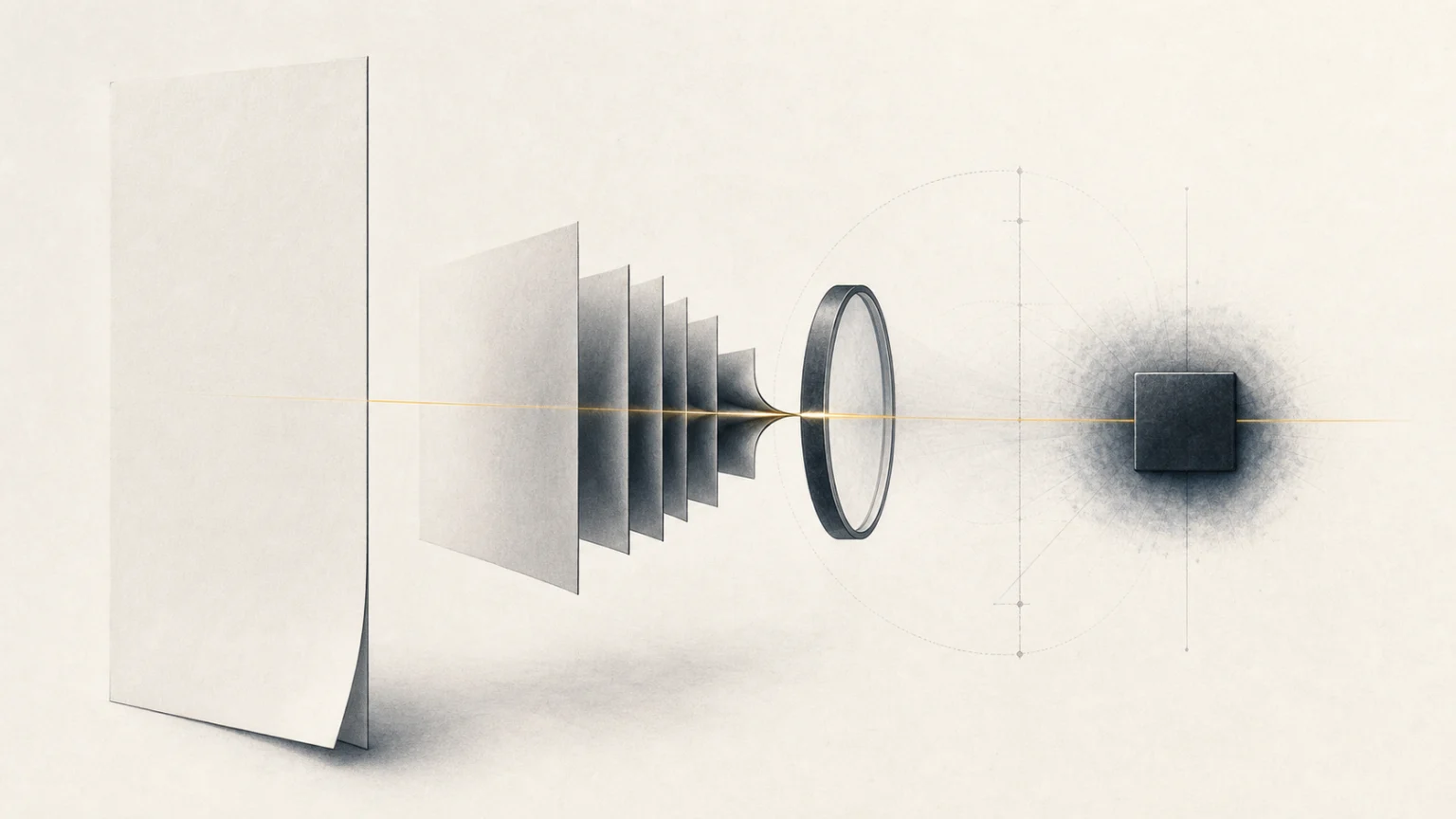
On October 21, 2025, three DeepSeek researchers published DeepSeek-OCR, a vision-language model that turns a page into a compact visual representation and generates its content again. The original preprint reported decoding precision close to 97% when the reference text contained fewer than ten times as many tokens as the visual tokens used by the model.
The result does not show that an assistant can store ten times more memory or that a bill becomes ten times cheaper. It measures OCR reconstruction in a bounded test. Interpreting any compression claim requires writing the full fraction—what is divided by what—and adding the sample, task, metric, quality, and cost of the whole pipeline.
The ratio compares two different tokenizers
In the study, compression is the number of tokens produced from the correct text divided by the vision tokens emitted by the encoder. If a page has 900 text tokens and the model represents it with 100 vision tokens, the ratio is nine. This does not mean a vision token occupies the same space, requires the same computation, or carries the same price as a text token.
DeepEncoder processes the image and reduces its features to a visual sequence. A mixture-of-experts decoder then generates text. Encoder work, the input image, activation memory, output generation, and communication between components remain in the system even when the intermediate counter is smaller.
The model uses different resolution modes. Tiny resizes to 512 by 512 pixels and produces 64 vision tokens; Small uses 640 by 640 and produces 100; Base reaches 1,024 by 1,024 and 256. Dynamic modes split large pages into local views and add a global view. “Tokens per page” therefore changes with resolution and layout.
The 97% belongs to one hundred pages and one task
The compression table uses exactly one hundred English documents from the Fox benchmark. The authors selected pages whose ground-truth text contained 600 to 1,300 tokens under the DeepSeek-OCR tokenizer. They tested Tiny and Small with a no-layout OCR instruction. The 97% summarizes the region below a ratio of ten, not every language, page, and resolution.
Distribution matters. In Small mode, the 28 pages containing 800 to 900 tokens reached 96.8% precision at an 8.5 ratio. Only four pages occupied the 1,200-to-1,300-token band; the reported result there was 87.1% at a 12.6 ratio. An attractive average can hide sparse evidence where compression is most aggressive.
The team reported roughly 60% near a ratio of twenty. That decline is not “fuzzy memory” already validated as a useful feature. The authors propose forgetting older context as a possible research direction. What the test observes is loss while reconstructing characters and formatting when the resolution must carry too much information.
Even 97% average precision must be translated into the harm caused by each error. Some mistakes may be tolerable in a literary archive; in a dosage, account, date, or clause, one digit may alter the decision. A production evaluation should measure accuracy by field type and the share of perfect documents, not only aggregate similarity.
Reconstructing text is not reasoning over it
The experiment compresses a page and asks the system to recover its text. It does not compare whether a model can answer questions, connect distant facts, cite an exact clause, or detect contradictions from vision tokens instead of original text. Those tasks can fail even when transcription looks good because the relevant error may affect the only word needed for an answer.
A memory test would hold the model, question, document, and budget constant while changing only the representation. It would then measure correct answers, verifiable citations, omissions, and cost. Queries targeting both old and recent details would be needed to determine whether declining resolution creates controlled forgetting or unpredictable loss.
The paper presents “optical contexts” as an initial investigation. DeepSeek-OCR itself is an operating OCR system for document images. It did not demonstrate an assistant that automatically turns conversation history into pictures and reasons over them. The memory proposal follows from a reconstruction result; it is not yet the result.
OmniDocBench uses a different metric
The second evaluation, OmniDocBench, measures edit distance, where lower is better. It covers text, formulas, tables, and reading order for English and Chinese documents. Its score should not be merged with the Fox precision percentage even though both appear under OCR.
DeepSeek reported that Small, using 100 vision tokens, beat GOT-OCR2.0 at 256. With fewer than 800 in Gundam mode, it beat MinerU2.0 in the published average; the table assigned MinerU roughly 6,790. Yet the paper’s own category breakdown shows layout dependence: newspapers required higher-resolution modes and more tokens than books or reports.
A useful comparison preserves five facts: exact version, input, resolution, valid versus allocated tokens, and distance by category. It also distinguishes end-to-end models from multi-component pipelines. Counting only input tokens misses preprocessing, secondary calls for charts, and later corrections.
Two hundred thousand pages per day is throughput, not total cost
The authors attributed output above 200,000 pages per day to the model on one 40-gigabyte A100 GPU. The figure describes their pipeline and hardware; it does not provide electricity use, GPU price, utilization, average output length, storage, human validation, or the share of pages requiring another attempt.
The official repository exposes the published environment, resolution modes, prompts, and inference paths. It identifies CUDA 11.8 and PyTorch 2.6, for example, alongside vLLM and Transformers execution. Reproducing throughput also requires pinning code, batch, files, and completion criteria.
To decide whether the system saves money, an organization should measure accepted pages per hour, not pages attempted. The denominator includes file reading, rendering, OCR, validation, retries, and storage; the numerator requires a field-level acceptance rule. It can then compare the old and new pipelines on the same corpus and quality threshold.
A six-line card prevents exaggeration
First: task, here text reconstruction. Second: ratio, reference text tokens divided by vision tokens. Third: sample, one hundred English Fox pages in a specific range. Fourth: mode and resolution. Fifth: metric and direction. Sixth: excluded costs and the test still missing, such as reasoning or retrieval.
DeepSeek-OCR contributes an open architecture and an interesting result about visual density. Its contribution is clearer when the claim is narrowed: on certain pages, the model reconstructs text from far fewer vision tokens than a text tokenizer produces. The transferable skill is refusing to stop at “fewer tokens.” Check what those tokens represent, what quality they preserve, and what it costs to turn them into a correct answer.
An internal test can stratify the corpus before execution: language, column count, type size, tables, scan quality, and field criticality. A held-out set should remain untouched during prompt tuning, with results published by stratum. Beyond average distance, count exact pages, omitted characters, changed numbers, and reading-order errors. If retrieval is evaluated, every answer should point to the supporting page region. This reveals whether savings come from compressing redundancy or from losing the difficult cases hidden by an average.
This article was produced with artificial intelligence under human editorial oversight.