Plagiarism and creative writing: what language models can detect
A match does not prove plagiarism, and an AI detector does not identify an author. Rigorous assessment combines retrievable sources, context, process records and human accountability.
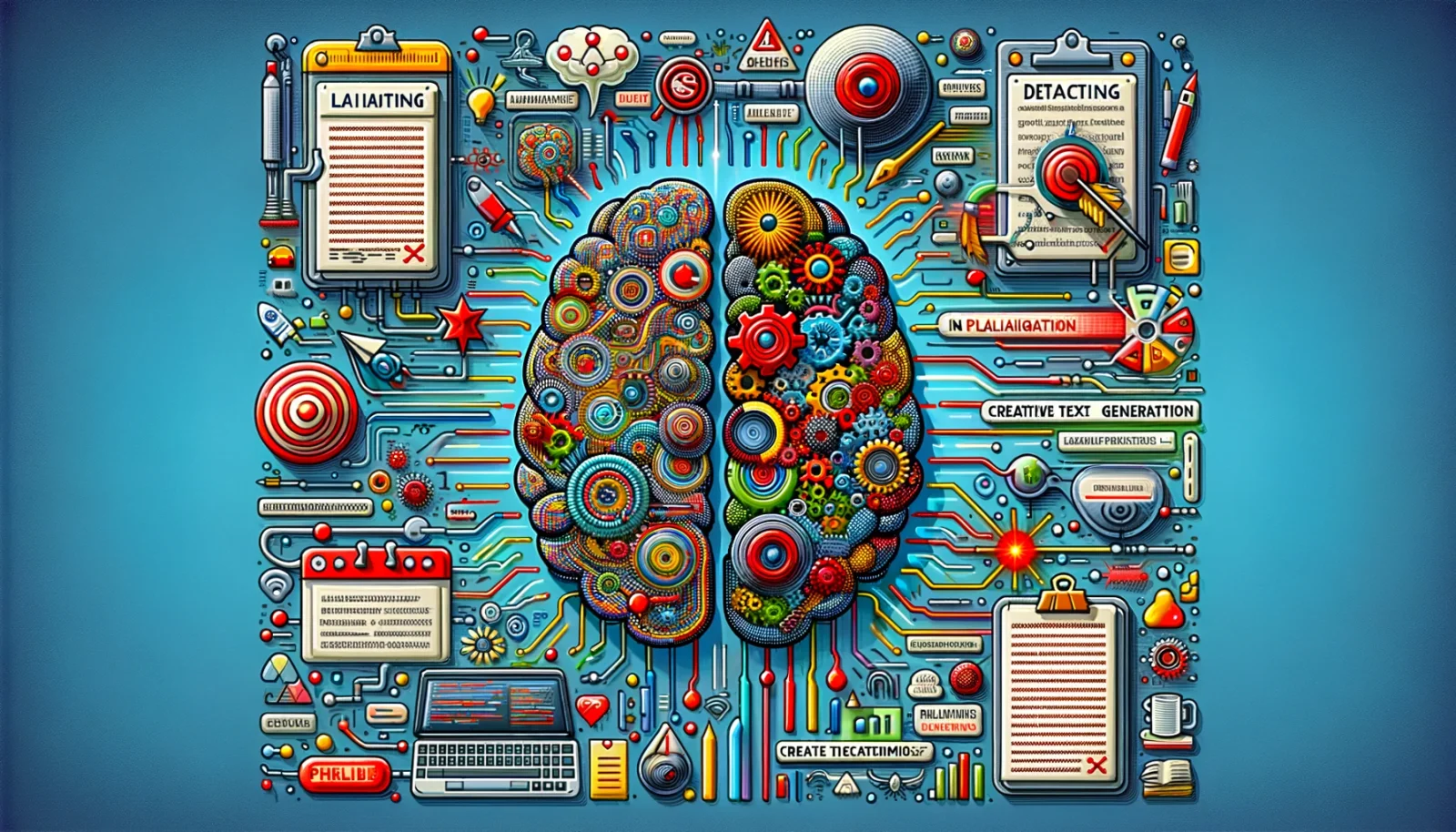
As of 30 July 2026, a language model can help locate similar phrases, search for paraphrases and propose a draft, but it cannot by itself determine whether someone plagiarised or who authored a text. Those conclusions require information not contained in the words alone: which sources the person consulted, which rules they accepted, what they disclosed, what they transformed and who takes responsibility.
Confusion arises because several tools produce a percentage. A similarity report displays matches against a corpus. An AI-writing detector estimates whether patterns resemble generated text. A semantic model retrieves passages with related meaning. None of those numbers is a plagiarism verdict. Plagiarism is a relationship between a work, its sources and attribution rules; it is not a statistical property of a sentence.
Three different questions should not share one answer
Does this text match another text?
Traditional tools split a document into fragments and compare them with web pages, publications or submissions in their database. They can find verbatim copying when the source is indexed. They also flag legitimate quotations, bibliographies, formulaic language and an author’s earlier drafts. Turnitin’s own guide therefore says that it does not check writing for plagiarism: it highlights similar text and leaves a human to determine whether misconduct occurred.
A high score may come from a long, properly attributed quotation. A low score may hide appropriation of an idea, a translation or a paraphrase of a source absent from the database. The report answers “what resembles what inside this corpus?”, not “was there deception?”.
Does this passage reformulate a source?
Semantic-representation models turn passages into vectors and search for closeness of meaning even when the wording differs. They are useful retrieval tools: they may connect a sentence with a possible source that literal search missed. They also generate noise. Two correct definitions of the same concept may look alike; conventional language may appear in thousands of works; and a model can find thematic kinship where no dependency exists.
The right output is not “82% plagiarism,” but an inspectable pair: passage in the work, passage in the source, link, date and an explanation of the relationship. A reviewer can then examine attribution, the degree of transformation and the relevant rules. A system that accuses without letting users open the source is asking for faith.
Was this passage written by AI?
This is a separate task. AI-text detectors commonly measure statistical regularities, use a classifier trained on examples or look for a mark inserted by a generator. They may work under defined conditions, but results shift with length, language, model, editing and the distribution of texts used in evaluation.
Can AI-Generated Text be Reliably Detected? showed that paraphrasing can lower the detection rate of several methods and that a watermark can even be imitated to make human text appear generated. A separate study, GPT detectors are biased against non-native English writers, found that evaluated detectors more often confused writing by non-native speakers. These are experiments with specific designs and samples, not proof that every form of detection is impossible. They support one operational conclusion: a score should not become an accusation without additional evidence.
Why generation and detection are not symmetrical
A generative model produces a sequence from instructions and context. The user may retain the conversation, supplied documents and successive drafts. The detector commonly receives only the final text. It tries to reconstruct a missing process from a signal that may have changed with every edit. The more a person and machine collaborate, the less meaningful a binary label becomes.
“Used AI,” “plagiarised” and “broke a rule” are also not equivalents. One institution may permit brainstorming but prohibit generated final answers. Another may allow generation if it is disclosed. A writer can copy a human source without AI; another can use AI, verify every claim, rewrite and cite. Conduct must be assessed against a known rule and a documented process.
Assisted creativity does not remove responsibility
Models can vary a point of view, suggest structures, explore voices or produce material that a writer later selects and transforms. This may broaden the author’s options, but fluency is not novelty, accuracy or clean provenance. A model may repeat a cliché, invent a reference or generate a passage too close to material encountered in training without revealing where it came from.
Authorship also has a legal dimension that varies by country. As a documented example, the US Copyright Office concluded in January 2025 that using AI as a tool does not bar copyright protection, but generated material is protected only where sufficient human authorship exists; prompts alone do not necessarily provide the required expressive control. That conclusion interprets US law, not a worldwide rule or a measure of artistic quality.
The responsibility test is even clearer in scientific publishing. The ICMJE recommendations ask authors to disclose how AI tools were used, reject chatbots as authors and keep humans accountable for accuracy, integrity, originality and citations. A machine may contribute; it cannot answer a challenge, disclose a conflict of interest or correct a paper.
A method stronger than a single detector
A sound integrity review combines product and process evidence:
- Define the rule in advance: which AI uses are allowed, which require disclosure and which ability the assignment measures.
- Keep proportionate records: outline, notes, sources, versions, editorial decisions and, where appropriate, relevant interactions with the tool.
- Retrieve sources: every important match should lead to the document and passage that make review possible.
- Ask for an explanation: the person should be able to defend the thesis, reconstruct decisions and correct mistakes.
- Separate signal from conclusion: similarity or detection may open a review; neither should close it alone.
- Allow challenge: before a sanction, communicate the evidence and let the affected person provide context, correction or appeal.
UNESCO’s Guidance for generative AI in education and research, published on 7 September 2023 and updated in January 2026, calls for pedagogical and ethical validation of tools, protection of human agency and redesigned assessments when machines can already perform the task being measured. The aim is not to police every adjective, but to design an assessment in which intellectual work becomes visible.
How to use a model without surrendering your voice
Responsible creative or academic writing can separate functions. First, the person defines the purpose, audience, sources and claims they must support. They then assign the model a bounded task: generate alternatives, challenge a structure or identify gaps. Next, they check every factual claim against the original source, decide what to keep and rewrite. Finally, they record the tool’s contribution according to the rules of the context.
This method produces a better question than “how much of this text is AI?”: which expressive and intellectual decisions can the person explain and defend? A version history does not guarantee honesty, and the absence of one does not prove fraud. Sources, drafts and explanation nevertheless provide evidence far more relevant than the statistical texture of prose.
The reading card
Whenever a system claims it can detect plagiarism or certify originality, ask:
- Object: does it detect matching text, semantic similarity, AI generation or a specific violation?
- Coverage: against which corpus, languages, genres and lengths was it evaluated?
- Evidence: can a reviewer open the source and inspect the passage?
- Error: does it report false positives and false negatives under comparable conditions?
- Procedure: who interprets the signal, and how can the affected person respond?
The transferable skill is this: separate matching, plagiarism and AI authorship, and reject any accusation that does not show a source, context, error rate and a right to explain the process. Language models can improve retrieval and enrich creation. A judgement about originality still requires traceable evidence and an accountable human.
This article was produced with artificial intelligence under human editorial oversight.