Physics Nobel honors Hopfield and Hinton for neural networks
John Hopfield and Geoffrey Hinton have won the 2024 Physics Nobel for ideas that made modern neural networks possible. The award recognizes the deep connection between statistical physics and machine learning.
On October 8, 2024, the Royal Swedish Academy of Sciences awarded the Physics Nobel Prize to John J. Hopfield and Geoffrey E. Hinton for discoveries and inventions enabling machine learning with artificial neural networks. The official decision and explanation make it possible to separate each researcher’s historical contribution from present systems that inherited those ideas.
The prize is worth 11 million Swedish kronor, which the two researchers will share. The decision puts a field commonly associated with computer science at the center of physics, even though its history is closely tied to the study of complex systems, energy and randomness.
A memory built from artificial neurons
John Hopfield, professor emeritus at Princeton University, developed a type of neural network in the early 1980s that could store and retrieve patterns. His proposal, known as the Hopfield network, can be understood as an associative memory.
The idea is easy to illustrate with a simple example: if a network has learned an image or a word and receives an incomplete or noisy version, it tries to reconstruct the original pattern. It does not do this by searching for an exact copy in a database. Instead, it adjusts the connections between its artificial units until it reaches a stable state.
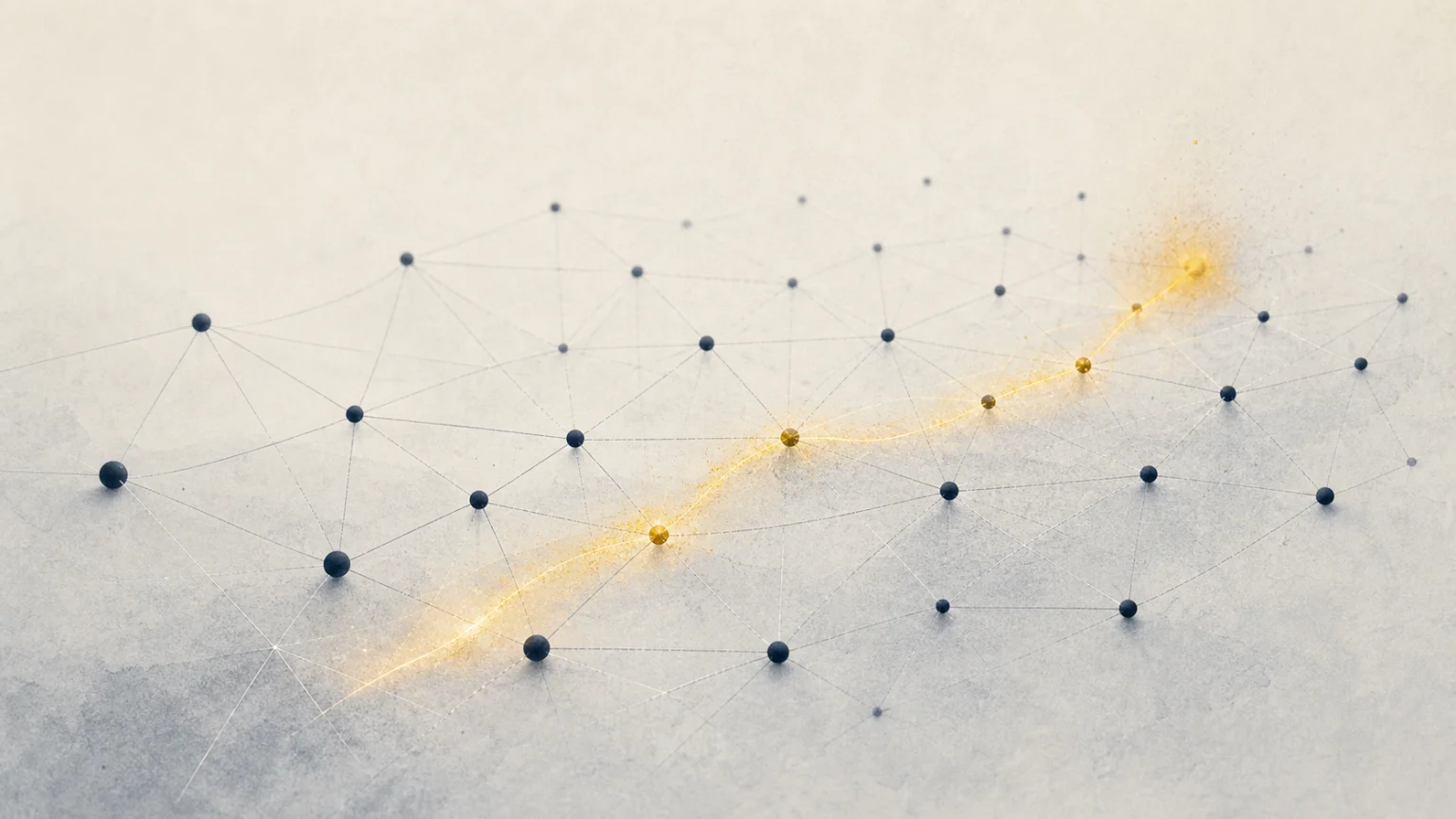
Hopfield found a way to describe this process using tools from physics. His network behaves like a system seeking to reduce a quantity known as energy, just as certain physical systems tend toward more stable configurations. Each memory is represented as one of these energy minima: when a partial signal is introduced, the network evolves toward the closest matching minimum.
Those networks were very different from today’s large models. They had limited capacity and could not handle the language, image or video tasks that have since become widespread. But they made a decisive contribution: they showed that a neural network could be formulated mathematically, analyzed and used to retrieve information from imperfect examples.
Hinton and learning from data
Geoffrey Hinton, a University of Toronto researcher and one of deep learning’s most influential figures, later developed methods based on statistical physics to help networks learn structures present in data.
His work on so-called Boltzmann machines made it possible to explore how a network can discover regularities without a programmer having to write a rule for every case. A Boltzmann machine is a network that assigns probabilities to different configurations of its units. During training, it adjusts the strength of its connections so that the learned patterns increasingly resemble the examples it receives.
That approach was computationally expensive for the computers of its time, but it established principles that would prove crucial later on. Modern neural networks also learn by adjusting millions or billions of parameters from vast amounts of data. The scale, architectures and computing power have changed radically; the central intuition remains that the system extracts patterns through repeated adjustments.
Hinton also became a central figure in the revival of deep networks during the 2010s. In 2012, work by his group at the University of Toronto, alongside Alex Krizhevsky and Ilya Sutskever, achieved a notable breakthrough in the ImageNet image-recognition competition with a deep network. That result accelerated the adoption of these techniques in computer vision and paved the way for many of the systems that now recognize images, translate text and generate content.
A Nobel for a technology already affecting every sector
The Swedish Academy has honored foundational research, not the generative AI products that have only recently reached the public. Still, the recognition comes as neural networks are embedded in everyday services, including spam filters, recommendations, assisted diagnostics, speech recognition, translation tools and conversational assistants.
It also helps explain why contemporary AI requires so much data and computing power. A neural network is not usually given explicit rules about what a cat is, how to translate a sentence or what code to write. It learns by adjusting its connections after processing a huge number of examples. This ability to generalize to new cases is useful, but it does not guarantee a correct result: models can make mistakes, reproduce biases in their training data or produce convincing but false answers.
The Nobel does not solve these limitations or certify that every application of neural networks is reliable. It does recognize that physics provided essential ideas for understanding how systems made up of many simple units can store information, recognize patterns and learn.
The choice also broadens the public image of the Nobel Prize in Physics. In recent years, the discipline has honored everything from quantum entanglement to climate research. This year, it recognizes a scientific foundation of artificial intelligence just as companies, governments and citizens are trying to decide where it should be used and what safeguards should govern it. Hopfield and Hinton’s research helps explain why these machines can learn; the remaining challenge is deciding how to deploy them responsibly.
A genealogy is not a complete explanation
The prize recognises foundational methods, not a single exclusive line to every contemporary model. The Academy’s scientific background places Hopfield networks and Boltzmann machines within a broader history. Data, accelerators, backpropagation, architectures and scaling added later pieces. Attributing all present AI to two inventions erases those dependencies.
A Hopfield network can be understood as associative memory. Each learned pattern forms a low-energy region; an incomplete input evolves toward a nearby state. The transferable idea is the landscape: optimisation moves across a surface defined by a function, and the result depends on minima, barriers and starting point.
The Boltzmann machine uses variables and probability to learn regularities from examples. It is not a miniature ChatGPT. It teaches another durable pattern: a generative system learns a distribution and produces samples compatible with it without necessarily storing a literal answer for every query.
How to read a technical prize
Separate the official citation, original contribution and later uses. Identify the mathematical object each person introduced, the problem it addressed at the time and the pieces of current technology that were absent. A prize’s prestige neither turns analogy into mechanism nor settles disputes about modern applications.
A small experiment helps. Build several binary patterns, corrupt one and observe which state an associative memory reaches. Change the number and similarity of patterns. When the network confuses memories, the limit appears: capacity and robustness depend on representation and set, not merely on “having learned”.
The transferable skill is to reconstruct the chain from idea to mechanism, evidence and application. It reveals when historical news genuinely explains technology and when a famous name merely lends authority to a much broader claim.
The limit belongs to the legacy too
An associative memory retrieves patterns close to learned ones but may converge on spurious states or confuse similar memories. Recording those failures prevents “works like the brain” from becoming an explanation: biological inspiration does not imply functional equivalence.
The same caution applies to energy. It is a mathematical function ordering model states, not a measurement of electrical consumption or evidence of consciousness. Naming variable, equation and role prevents a physical metaphor from acquiring conclusions absent from the mechanism.
This article was produced with artificial intelligence under human editorial oversight.