AI helps read Herculaneum scrolls without opening them
Virtual unwrapping combines tomography, geometry, ink detection and philology. A guide to auditing the full chain from scroll to sentence.
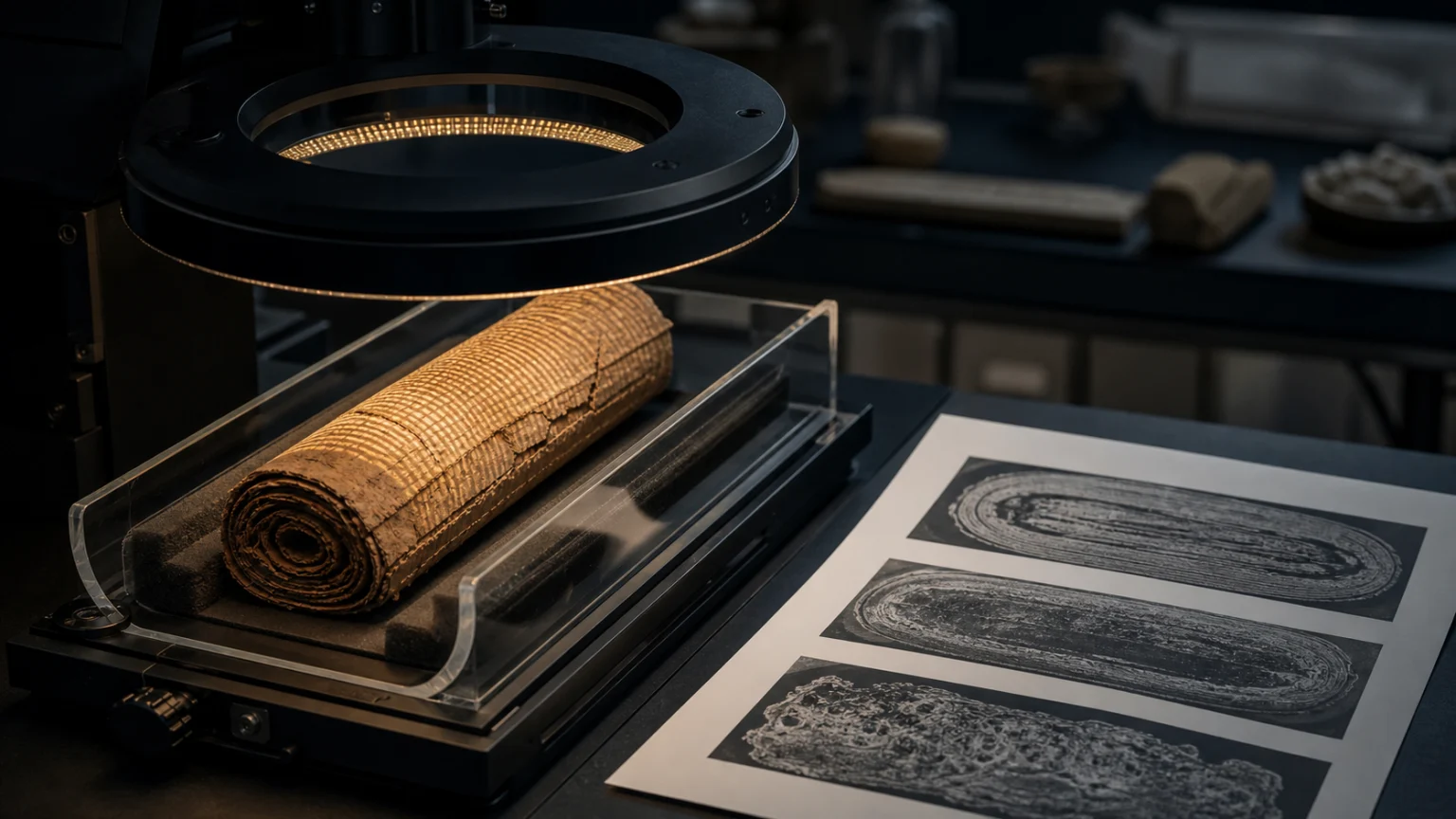
On 25 June 2026, the Vesuvius Challenge announced that it had reconstructed the surviving part of a carbonised Herculaneum scroll from end to end and recovered extensive text from other examples without physically opening them. The news is not that an artificial intelligence read a Roman library on its own. It is that a chain of instruments, computational geometry, ink-detection models and philology is beginning to produce pages that other specialists can inspect. Understanding that chain is how a reader can distinguish a sound archaeological reading from an attractive algorithmic image.
The results presented in Naples include nearly 1.5 metres and about 20 columns of text from PHerc. 1667, more than 70 columns from PHerc. 172, and the identification of works attributed to Philodemus. Those figures and attributions come from the University of Kentucky announcement, which also makes an essential limitation clear: only part of PHerc. 1667 survives. “Complete” in this context means that the surviving portion was processed from end to end, not that an intact ancient book has been recovered.
The visible result has four layers
The papyri were carbonised by the eruption of Mount Vesuvius in AD 79. Mechanical opening can separate, distort or destroy layers that have been compressed for centuries. Virtual unwrapping replaces that irreversible gesture with four testable operations. First, X-ray tomography turns the object into a volume of small three-dimensional elements, or voxels. Researchers then locate a papyrus surface within that volume. The curved surface is represented as a mesh and flattened. Finally, a model estimates where ink may be present, and a papyrologist decides whether the shapes support readings of letters, words and arguments.
Each rung can fail in a different way. A scan with insufficient resolution does not contain the necessary detail, however good the model may be. Segmentation that jumps from one sheet to its neighbour joins areas that were never adjacent. Flattening can stretch or duplicate strokes. An ink detector can turn natural texture into false letters. And a genuine graphic sequence may still allow more than one philological restoration. “AI read the scroll” is therefore an impoverished description: it removes the instrument, geometry and human interpretation that make the result testable.
The Vesuvius Challenge’s own technical overview says where the frontier currently lies. Tomography yields voxels, not columns; surface tracing remains semi-automated and fails where sheets are tightly packed or torn. Ink has surfaced on nine of the 45 scanned scrolls and fragments, but it is not always legible. These facts are more useful than a general promise because they provide the denominator and separate a successful case from a universal solution.
Seeing the support is not the same as seeing the ink
The physical problem is counter-intuitive. In many of these manuscripts, both the carbonised papyrus and the ink are composed largely of carbon. A radiograph may represent folds, fibres and gaps well while offering very little attenuation contrast between writing and support. Researchers therefore look for weaker signals: local differences in texture, composition or relief, learned from opened fragments where the locations of ink are known.
A study published on 18 June 2026 in Scientific Reports tested whether surface topography contains usable information. The team trained a model on three-dimensional optical profilometry from opened papyri and found that it could distinguish inked and uninked regions in the assembled dataset. But the paper does not claim to have discovered universal letter relief. Transfer when leaving out one papyrus at a time was heterogeneous, and performance deteriorated as lateral resolution was reduced. Its cautious conclusion is a proof of concept conditioned on the data and the imaging modality.
That fine print provides a durable way to read any computer-vision result. Ask which objects supplied the labels, whether whole objects were separated between training and evaluation, and what happened when the scanner, resolution or conservation state changed. Randomly splitting small tiles from the same surface can inflate performance: during training, the model sees the distinctive texture of the object that later appears in the test set. Holding out an entire papyrus is harder because it better measures generalisation to a new artefact.
Geometry matters as much as the model
Before searching for ink, researchers must find the correct sheet inside a deformed block. Imagine a newspaper crumpled, burned and compressed until neighbouring pages almost touch. A mistaken path through the volume can create an apparently continuous surface assembled from pieces of different pages. The detector might mark genuine signals, yet the resulting sentence may never have existed on the object.
A convincing demonstration therefore shows more than a flat image. It should be possible to travel back from each legible area to the three-dimensional surface, the tomography volume and ultimately the catalogued artefact. The project’s technical manuscript on the first end-to-end unwrapping records that chain in its report on PHerc. 1667. Spatial traceability matters more than a crisp appearance: an enhanced image without coordinates or a process version is difficult to audit or reproduce.
The source data are not conventional photographs either. ESRF explains that its BM18 beamline uses a fine, stable beam to construct high-quality three-dimensional representations; some scans reached as much as 300 terabytes per scroll. The facility’s official account connects those images to the later unwrapping and neural analysis. Size does not guarantee truth, but it shows why the bottleneck includes storage, calibration, reconstruction and review, rather than merely training a network.
A reading requires philological evidence
The final step changes discipline. An ink-probability map does not automatically contain a Greek text. Specialists identify hands, compare letter forms, propose word divisions, mark gaps and assess possible restorations. The identification of “Philodemus, On Gods, Book 8” in PHerc. 139 depends on a visible sequence, a reading of the name and numeral, and its relationship to known works. The attribution becomes stronger when several clues converge, not because a system assigns a high-confidence label.
Discovery should also be separated from confirmation. In February 2025, the Bodleian Libraries had already announced the first interior image of PHerc. 172 after it was scanned at Diamond Light Source. Its institutional statement said at the time that Oxford scholars were still interpreting the text and work was continuing. The June 2026 presentation added more than 70 columns and a specific identification. That sequence shows how a scientific claim should mature: from observed signal to provisional reading and then to a defensible edition.
Uncertainty does not diminish the discovery. It identifies what can be checked and what remains open. “Probable Stoic treatise”, “title still unknown” or “uncertain reading at a fold” contain more information than a seamless reconstruction presented as fact. The transferable rule is to require outputs to preserve their gaps. When a system silently fills what it cannot see, the reader can no longer tell what comes from the object and what comes from expectation.
How to audit the next “impossible reading”
The same test applies to any story about AI recovering a manuscript, inscription or medical image. What is the precise object, and who holds it? Which instrument generated the data, and at what resolution? How was the reference used for training or validation obtained? Was evaluation performed on unseen objects? Can a letter be traced from the processed image back to the original volume? Who interprets the output, and how are doubts represented? A clear answer at every step forms an evidence chain; an undocumented jump remains a hypothesis, however compelling the picture looks.
At Herculaneum, open collaboration also makes that scrutiny easier. The challenge has released three-dimensional imagery and software, while scientific facilities, libraries and papyrologists perform different roles. This does not eliminate bias or error, but it gives a claim several points of inspection. The goal is not to reward the algorithm that produces the prettiest letters. It is to recover texts that can become critical editions and withstand expert disagreement.
The practical capacity this advance leaves with the reader is simple: reconstruct the whole route from artefact to sentence. Scanner, surface, ink and reading are four separate tests. If a report shows only the last, the route is missing; if it documents all four and preserves uncertainty between them, artificial intelligence stops being a magical explanation and becomes an auditable scientific tool.
Sources for this piece
This piece draws on 3 primary source(s), gathered during reporting.
This article was produced with artificial intelligence under human editorial oversight.