
Chemistry Nobel Honors AlphaFold and Protein Design
Demis Hassabis and John Jumper of Google DeepMind share the Chemistry Nobel with David Baker. The award recognizes AI-powered protein structure prediction and the computational design of new proteins.
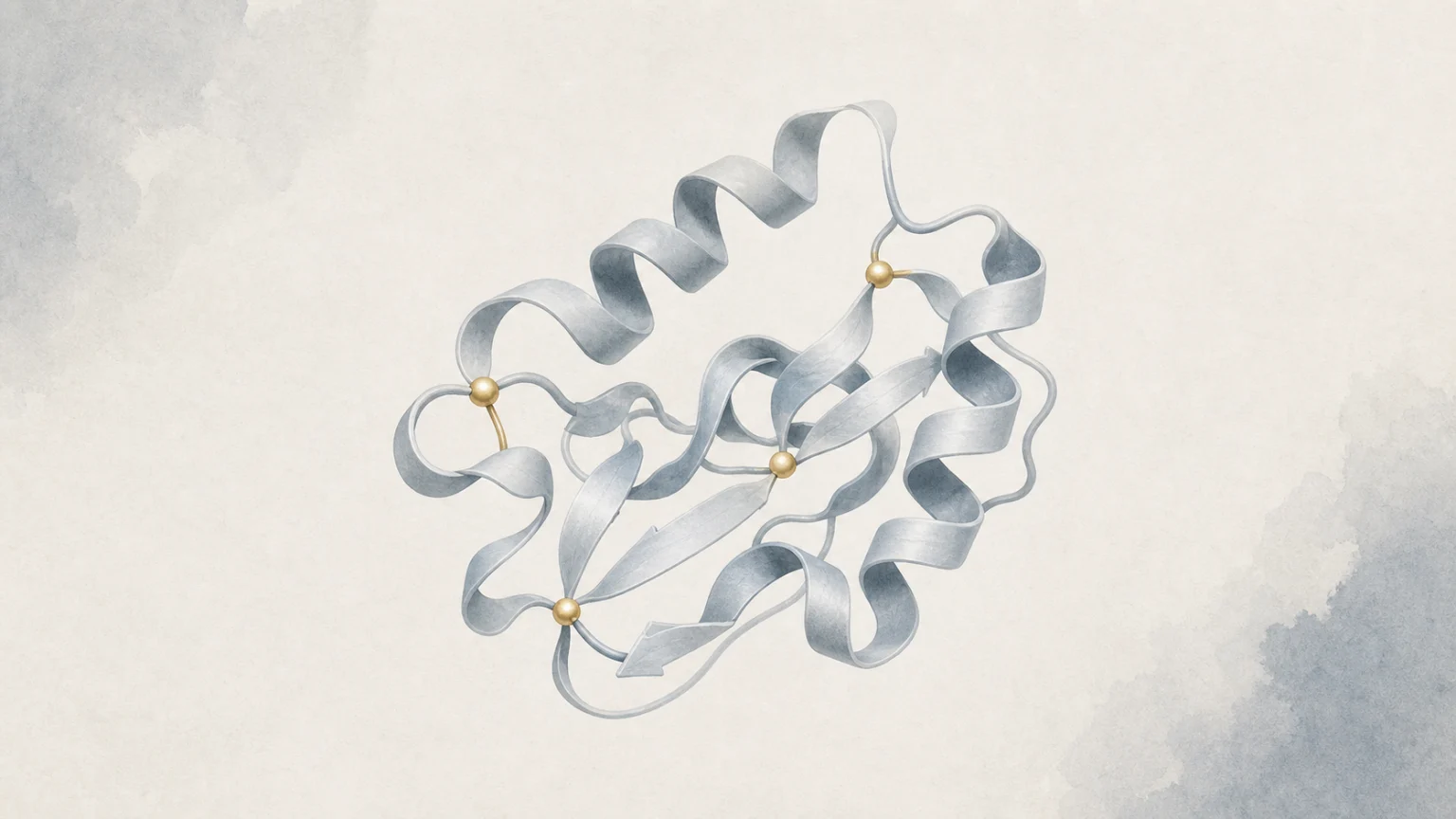
On October 9, 2024, the Royal Swedish Academy of Sciences awarded the Nobel Prize in Chemistry to David Baker for computational protein design and to Demis Hassabis and John Jumper for protein-structure prediction. The official Nobel release explains the split and the recognised work; the prize honours scientific methods rather than certifying every future prediction made by a tool.
The Royal Swedish Academy of Sciences has recognized Baker for computational protein design and Hassabis and Jumper for protein structure prediction. The award places AI at the center of a field where knowing the shape of a molecule can be just as important as knowing its composition.
The shape that determines function
Proteins are long chains of amino acids. Once produced by cells, those chains fold into three-dimensional structures. That geometry determines, for example, whether a protein transports oxygen, speeds up a chemical reaction or binds to a virus.
The problem is that predicting this shape from an amino acid sequence has been one of biology’s great challenges. For decades, determining a protein’s structure required complex and expensive experiments, such as X-ray crystallography, nuclear magnetic resonance or cryo-electron microscopy. These techniques remain fundamental, but they cannot keep pace with the rate at which genetic sequences are being discovered.
AlphaFold changed the relationship between biological data and structure. DeepMind’s first version made headlines at CASP in 2018, an international assessment that compares prediction methods. AlphaFold2, introduced in 2020, marked the decisive leap: for many proteins, it achieved accuracy close to that of experimental methods.
The system analyzes a protein’s sequence and large databases of evolutionarily related proteins. Using that information, it estimates which parts of the chain will be close to one another and builds a prediction of its structure. It does not physically observe the molecule; it infers its shape from patterns learned from biological data.
From a demonstration to scientific infrastructure
The recognition is not just for a competition result. DeepMind and the European Molecular Biology Laboratory, through its European Bioinformatics Institute, launched the AlphaFold Protein Structure Database. The platform provides predictions for more than 200 million proteins, freely accessible to researchers around the world. Primary source.
That does not make every prediction a definitive structure. AlphaFold accompanies its results with confidence scores and performs less well in some flexible regions of proteins or in systems where interactions between multiple molecules are especially important. Experiments are still needed to verify results, study specific mechanisms and develop medicines.
But the practical difference is enormous. A team can now consult a structural hypothesis within minutes before deciding which experiments are worth carrying out. In basic research, this can help assign functions to poorly studied proteins. In medicine, it facilitates the analysis of disease-linked mutations and the study of drug targets. In biotechnology, it speeds the search for enzymes capable of carrying out industrial reactions or breaking down pollutants.
David Baker and the proteins that never existed
The other half of the Nobel recognizes a different but complementary step: not limiting research to deciphering natural proteins, but designing new ones with a specific function.
David Baker has spent decades developing Rosetta, a suite of computational methods for modeling and designing proteins. In 2003, his group presented Top7, a computer-designed protein whose structure did not resemble any known in nature. It showed that the physical and chemical rules governing folding could be used in reverse: starting with a desired function or shape and searching for a sequence capable of producing it.
This capability opens the door to proteins designed for specific tasks: more efficient catalysts, materials with novel properties, sensors or therapeutic molecules. Baker’s research has also helped fuel current tools that combine machine-learning models with physics-based simulations to propose thousands of candidates and select which ones to make and test in the laboratory.
A Nobel for a hybrid science
The prize awards 11 million Swedish kronor among the three researchers and sends a clear signal: AI is no longer just a tool for classifying images, writing text or recommending content. It has also become an instrument for formulating hypotheses in the natural sciences. Primary source.
That advance should not be mistaken for a replacement for experimental research. AlphaFold and protein-design systems depend on data accumulated by biologists, chemists and structural biologists over decades. Their greatest value lies in making that work more productive: narrowing the space of possibilities, suggesting explanations and guiding experiments.
For Google DeepMind, the Nobel also reinforces a direction that departs from the usual competition over conversational assistants. The company introduced AlphaFold3 last May, a new generation designed to model interactions between proteins, DNA, RNA and small molecules. The challenge now will be to translate that predictive capability into verifiable results in laboratories, treatments and industrial processes.
A prediction carries its own warning
AlphaFold produces coordinates and confidence measures. A low-confidence region may be flexible, disordered or dependent on a molecular partner absent from the input. Users should not crop the warning to keep a clean picture: local confidence and domain relationships determine which hypothesis deserves an experiment.
The right comparison is not “computer versus laboratory”. Prediction narrows candidates and helps design a test; crystallography, microscopy, biochemistry and mutagenesis observe the physical system. When they disagree, the difference may reveal state, environment or interaction rather than a simple winner.
From a file to an experimental decision
A reproducible workflow preserves sequence, model version, databases, parameters and date. It then states the question: locating a site, comparing a mutation or designing an interaction. Choose a measurement capable of refuting the hypothesis and decide in advance what result would make the team abandon it.
For protein design, proposing a sequence is the beginning. It must be manufactured, checked for folding, measured for stability and tested for function under relevant conditions. Computational filters save experiments; they do not turn candidates into effective or safe molecules.
Read the Nobel without turning it into a brand
The prize recognises two complementary capabilities: inferring structures from sequences and creating proteins evolution had not supplied. Both rest on decades of data and experimental method. AI provides a way to search a huge space while material evidence decides what exists and works.
The pattern extends to other sciences. Ask what the model represents, which observations taught it, what uncertainty it supplies and which experiment closes the loop. A striking result without those four answers is a suggestion rather than a discovery.
Public documentation also enables a scope check. A static structure does not by itself describe concentrations, chemical modifications, membranes or reaction time. Researchers record omitted dimensions and prevent a three-dimensional picture from appearing to contain phenomena the model never calculated.
Confidence indicators are not comparable without a definition either. Consult the model guide and set a threshold for the specific question; an uncertain region may be the object of study. Publishing the prediction with uncertainty lets another team repeat the selection and dispute the criterion instead of receiving only an attractive figure.
The transferable skill is to read a scientific prediction as a hypothesis with a version, confidence and falsification test. The habit captures AlphaFold and protein-design systems without treating them as oracles and explains why the laboratory remains part of the honoured method.
This article was produced with artificial intelligence under human editorial oversight.