
Genesis: The Generative Physics Engine Speeding Up Robotics
A consortium of universities unveils Genesis, an open-source physics simulation engine that generates 4D worlds from text and promises to dramatically speed up robot training.
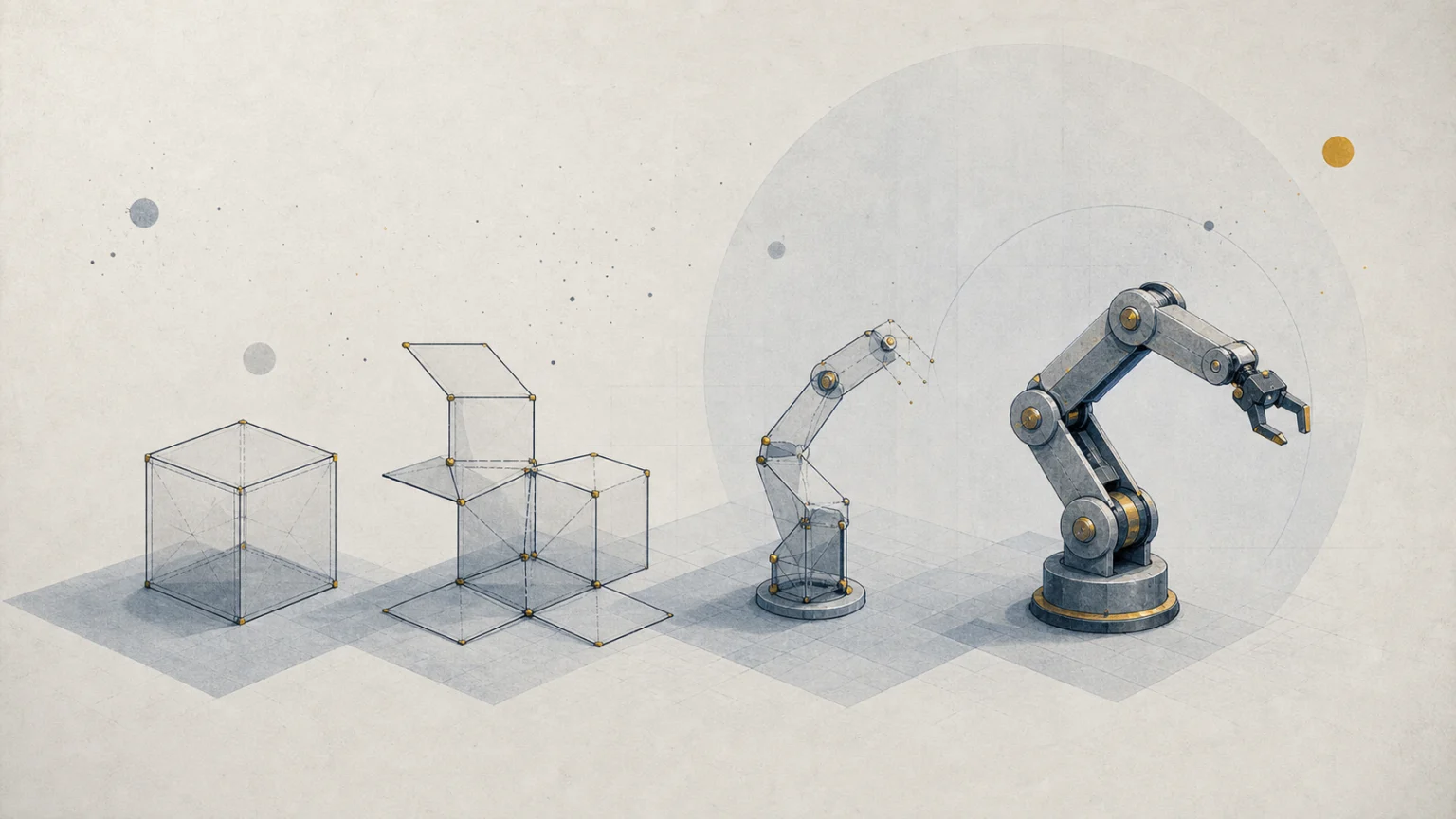
A Simulator Born From the Academic Community
Genesis, a simulation platform for robotics and embodied AI, became public on December 19, 2024. Its repository made the physics engine and simulation platform available to download, run and audit. Those were the components that were actually open.
The same project document separated that release from the generative framework intended to turn descriptions into data and dynamic worlds. That framework was modular and access was to be rolled out gradually.
Why Speed Is the Central Selling Point
The team claims simulation speeds notably faster than existing tools. That difference matters because training a robot through reinforcement learning requires millions of trial-and-error attempts: the more simulations that can run per second, the less time and hardware an algorithm needs to learn to walk, grasp objects, or navigate an unfamiliar space.
Until now, that training relied on existing simulators — solid tools, but limited by physics engines that typically model one type of material or interaction well at a time: rigid bodies, fluids, or soft tissues. Genesis aims to unify different kinds of physics under a single architecture, so a single environment could include, say, a rigid robot manipulating a soft object inside a liquid, without switching engines.
The Problem It's Trying to Solve: The Real-World Data Shortage
Embodied robotics has long struggled with the same bottleneck that held back computer vision before massive datasets like ImageNet arrived: there simply isn't enough real-world data of robots interacting with the world to train generalist models. Collecting that data with physical robots is slow, expensive, and hard to scale.
The generative vision behind Genesis was to produce synthetic variety and automate part of data creation. But on December 19, typing a description of a kitchen, warehouse or street did not provide that whole pipeline as open code. Evaluating the actual release required separating the downloadable engine, runnable examples and modules promised for later access.
What Remains to Be Proven
A fast engine that generates varied worlds doesn't guarantee that what's learned in those worlds will work outside them. The leap from simulation to reality remains robotics' classic bottleneck: small differences in friction, lighting, or weight between the simulated and real world can make a robot that walks flawlessly in Genesis stumble the moment it touches a lab floor. The robotics community will spend months assessing whether Genesis's promise of speed and generative power translates into more capable robots beyond the screen, or whether it ends up as just another tool that speeds up research without fully closing that gap.
For now, its open release — with the code available for any research group to test — is itself significant news for a field where the flashiest advances often stay locked inside private labs with restricted access.
Speed needs a unit
Calling a simulator “fast” is not enough. Report simulated seconds per wall-clock second, parallel environments, scene, solver, timestep, precision, hardware and compilation time. The repository offered examples and team performance claims; an independent comparison must run the same problem in every engine and preserve configuration.
An extreme number may describe a small parallel scene rather than a complex robot with contact, sensors and rendering. It may also omit asset preparation or data transfer. The useful criterion is not the peak but the time required for a reproducible experiment to reach an outcome at an acceptable error level.
Physics, representation and robot policy
A simulator has at least three layers. The engine calculates changes in positions, forces and materials. Synthetic sensors turn the world into images or measurements. A policy learns to act from those observations. Improvement in one layer does not guarantee transfer in the others: a perfect camera with wrong friction, or accurate physics with poor textures, may produce a brittle robot.
Sim-to-real is tested by varying parameters, not by declaring it. Policies can train across ranges of mass, friction, delay and noise; a held-out set then tests unseen conditions before controlled hardware trials. Reporting should include success, failure and damage rather than one selected demonstration.
Fidelity means measured error
An engine may represent rigid bodies, liquids, cloth and deformable materials while approximating every interaction differently. The question is not how many types appear in a feature list, but how far simulation departs from a reference. A fall can compare trajectory, bounce and energy; a grasp can compare force, slip and success; a fluid can compare volume, velocity and numerical stability.
Validation needs simple cases before spectacular scenes. A pendulum, a box on an incline or a controlled collision can expose unit, integrator, contact and energy-loss problems. Complexity comes later. If an engine fails an isolated test, a demonstration with many objects may hide the error behind a persuasive image.
Reproduction is more than installation
A repository installing successfully does not guarantee that a result can be repeated. The exact code revision, driver version, assets, seed, hardware and command are required. Full metrics must be saved as well as video. An open licence permits investigation; documentation and tests determine how expensive that investigation is.
Community work becomes valuable when someone can present a minimal case, run it elsewhere and discuss the same outcome. Early bug reports are part of learning about a new platform, not noise to remove from the story. Maturity means known limits, fixes and compatibility are visible and versioned.
For an adoption decision, a laboratory can fix one small task and budget: install from scratch, reproduce an example, replace an asset, train a policy and document transfer to a robot. Human hours belong beside GPU time. A platform that saves compute but needs weeks of integration may remain valuable, although for a different reason from the advertised speed.
What open actually means
An open project lets people inspect the licence, code, dependencies, examples and change history. It does not imply that every dataset, asset, generative model or service is available. In Genesis, the README stated that boundary. Reading it before the headline would have prevented attributing a roadmap capability to the repository.
The transferable skill is to separate demonstration, delivered component and complete system. For any “world” engine, ask what can be downloaded today, what runs without a private service, which benchmark reproduces the speed and which test reaches physical hardware. Those answers turn a visual promise into a technical evaluation.
Correction note · 30 July 2026
What this piece said: “In December 2024, an academic team unveiled Genesis, a physics simulation engine built specifically to train robots and embodied AI agents. The project, led by researchers from several universities and robotics research institutions, has been released as open source — an unusual move for a system of this scale, and one that lets any lab use it, audit it, or modify it from day one.”
What it says now and why: The previous version of this article merged the available platform with the broader vision and described a component that had not yet shipped as open from day one. The README published by the project in December 2024 said that the physics engine and simulation platform were being open-sourced, while access to the generative framework's features would be rolled out gradually.
This article was produced with artificial intelligence under human editorial oversight.