A proposed law seeks to pause new AI data centers in the U.S.
H.R. 9442 would freeze the construction and upgrading of large AI data centers until Congress enacts safeguards. It is a bill in committee, not a law: we read what the text says and where it stands in the process.
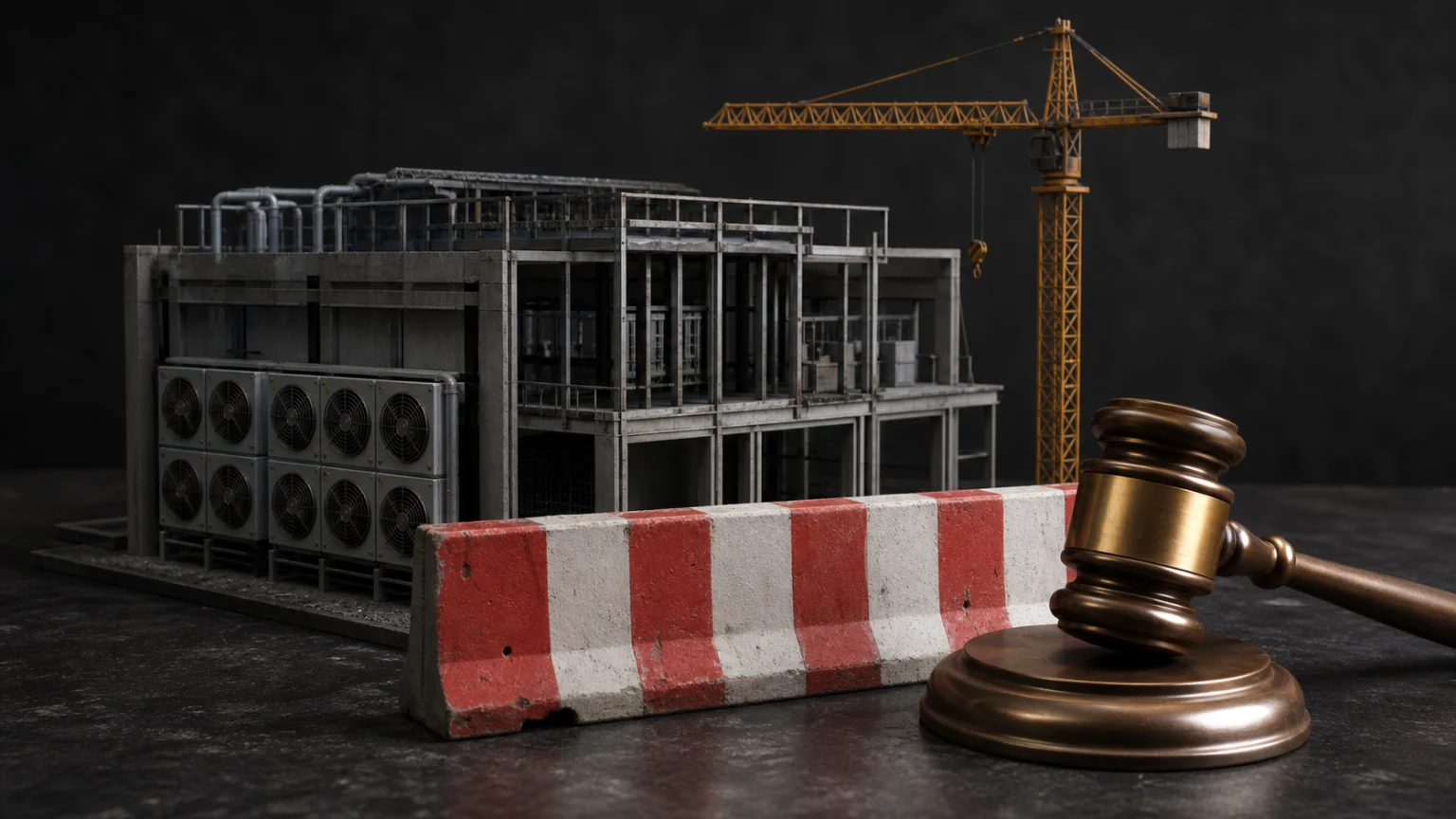
On July 21, 2026, U.S. Representative Terri Sewell announced that she is cosponsoring the Artificial Intelligence Data Center Moratorium Act. The name may suggest a ban already in force, but it is not: it is H.R. 9442, a bill that Alexandria Ocasio-Cortez introduced in the House of Representatives on June 24 and that was referred to committee. It has not been passed by Congress or signed into law — and that difference, between a bill and a law, is the capability you take away from this case.
What the text says, with its thresholds
The bill text is more precise than its nickname. Its official title is "to impose a moratorium on the construction of new data centers until legislation is enacted that safeguards the public from the dangers of artificial intelligence." The measure would freeze, upon enactment, "the construction or upgrading of new or existing AI data centers" — so it does not order the closure of those already operating, but it would halt large upgrades to current ones, a broader reach than the word "new" suggests.
And it defines with numbers what counts as one of those centers, which is where a law becomes concrete. A facility is covered if it occupies a single site or several contiguous ones under the same ownership and meets a power threshold: a maximum rated capacity or peak load above 20 megawatts, or the ability to deliver 20 kilowatts or more to a single server rack with specialized cooling — liquid circulation or submersion — provided it is used "for the development or operation of AI models at scale." That double criterion — total power or per-rack density — is designed to reach both the enormous halls and the small but very dense rooms where AI is trained. It is worth translating the numbers for the reader: 20 megawatts is the consumption of thousands of homes, the scale of a serious training center, not that of an office server closet. And the second criterion, 20 kilowatts per rack with liquid cooling, is an almost literal description of modern GPU racks, so dense that air no longer suffices to cool them. By drawing the line there, the bill does not chase any data center: it aims specifically at high-density AI infrastructure, and leaves out conventional web hosting.
A pause with a very demanding exit door
The moratorium is not open-ended by whim: it ends when Congress enacts a law that expressly lifts it and that addresses a far-from-minor list of conditions. The text requires a federal pre-market review approving the safety of AI products; wealth-sharing mechanisms so that AI's gains reach workers and not only the technology's owners; and a package of subsequent safeguards: no increases in electricity bills, no environmental harm, community rights to approve projects, no public subsidies, and unionized jobs with prevailing wages. Enforcement would fall to the Secretary of Energy, with quarterly public reports and verification powers that include subpoenas and inspections.
Read in full, the bill is not a technical pause: it is a broad political condition. Lifting the moratorium would require Congress to legislate on product safety, energy, the environment, subsidies, and labor law at once. That ambition is at once its backers' argument and the reason its passage would be difficult. It is worth noting the logical order it imposes: first you stop, and only afterward, once the protective law exists, do you resume. It is the opposite of the usual approach — build and regulate along the way — and that inversion is precisely what makes it as combative as it is unlikely in its current form.
Where it stands in the process — and why that matters
The news is a legislative move, not an applicable regulation, and the state of the process confirms it. H.R. 9442 was referred to two House committees — Energy and Commerce, and Foreign Affairs — and most bills never leave that stage. There is also a twin version in the Senate, S. 4214, introduced in March and referred to its committee; that the Senate one predates the House version indicates the idea had been circulating for months before the July announcement. To become law, identical text would have to clear the committees, be voted on the floor of both chambers, and be signed by the president. Presenting the bill as an immediate moratorium would misstate the process.
The two committees it was referred to say something about the framing. That one is Energy and Commerce is expected: the measure is, at bottom, about electricity. That the other is Foreign Affairs is more striking, and suggests its authors frame the race for AI infrastructure as also a matter of competition between countries, not just local zoning. A dual referral splits the bill across different jurisdictions and, in practice, multiplies the points where it can stall: each committee is a door to cross, not just one.
From that comes the checklist for reading any legislative headline: distinguish "a bill was introduced" from "a law was passed"; a title like "Moratorium Act" describes its authors' intent, not current law; "referred to committee" is the start of the road, not the end; and a version in each chamber is not double progress, but two tracks that must still converge on the same text. The House version is led by Ocasio-Cortez, with Sewell among its cosponsors; that it exists does not prove its diagnosis is shared by the legislative majority.
Why infrastructure entered AI policy
The debate shifts attention from the models to the infrastructure that lets them be trained and run. Data centers require land, energy, water, and networks; those decisions are made near specific communities, even though their services are used at a global scale. That the text sets the threshold in electrical power — not in square meters or number of servers — says something fundamental: the resource in dispute is electricity, which is why enforcement is entrusted to the Secretary of Energy and not to a technology regulator. It is not a minor point of administrative plumbing: it means the office that would police compliance is the same one that manages the grid and its strains, and that the bill's reference figures — 20 megawatts, 20 kilowatts per rack — are an electrical engineer's, not a computer scientist's.
That a proposal exists does not prove its diagnosis is shared, but it does show that AI's physical deployment has entered the discussion about resources, bills, and the sharing of benefits. The question a serious process would open is not only how many centers get built, but what transparency, what impact assessment, and what public participation are required before doing so. Until that is voted, the honest thing is to report the bill as what it is: a proposal with a concrete text and a long road ahead.
Sources
Sources for this piece
This piece draws on 4 primary source(s), gathered during reporting.
- Rep. Sewell Cosponsors Legislation to Pause AI Data Center Construction Until Federal Guardrails are Established
- H.R. 9442 — Artificial Intelligence Data Center Moratorium Act
- Ocasio-Cortez Introduces House Version of the AI Data Center Moratorium Act
- S. 4214 — Artificial Intelligence Data Center Moratorium Act
This article was produced with artificial intelligence under human editorial oversight.