AlphaFold 3 brings DeepMind AI to DNA, RNA and drugs
Google DeepMind and Isomorphic Labs have unveiled AlphaFold 3, which can predict complexes involving proteins, DNA, RNA and small molecules. The advance expands AI’s role in biology, although its results still require experimental validation.
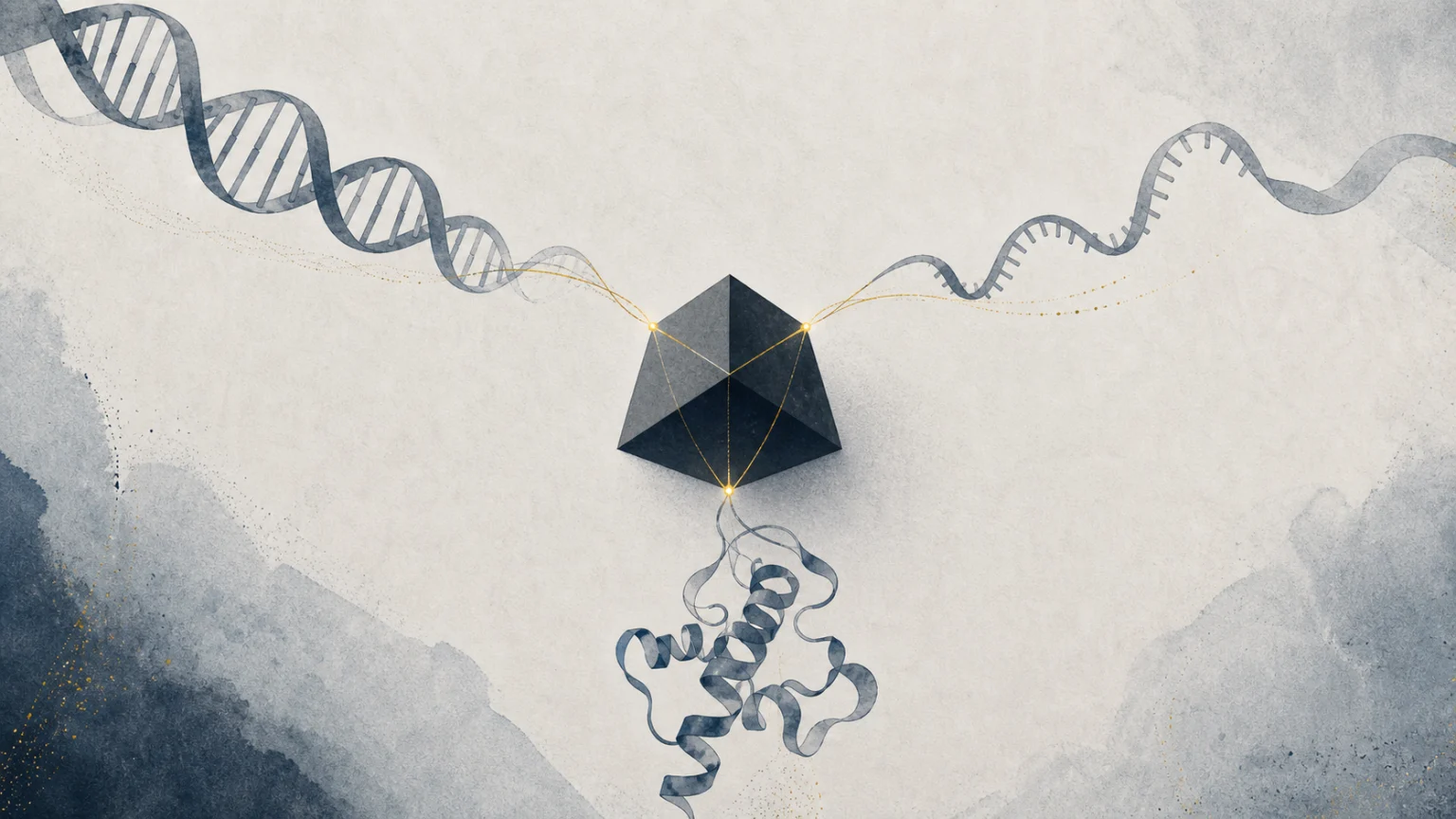
On May 8, 2024, Google DeepMind and Isomorphic Labs published AlphaFold 3, a system that predicts joint structures containing proteins, nucleic acids, small molecules, ions and modified residues. The Nature paper provides methods and evaluations; its output is a structural prediction with uncertainty, not experimental confirmation of a drug.
That matters because much of biology and drug development depends precisely on these interactions. An isolated protein can provide useful information, but many diseases and treatments are explained by the way a protein binds to another molecule inside a cell.
From folding proteins to reconstructing biological complexes
AlphaFold 2, unveiled in 2020, solved one of the major problems in computational biology: predicting a protein’s three-dimensional shape from its amino acid sequence. That shape determines its function. The system transformed the work of many laboratories by providing structural hypotheses in seconds or minutes—something that previously could require years of experiments.
AlphaFold 3 expands that approach. Rather than estimating only a protein’s geometry, it attempts to generate the combined structure of a molecular complex—for example, a protein bound to a fragment of DNA, an RNA molecule or a chemical compound.
Small molecules are especially relevant to the pharmaceutical industry. A drug typically works by binding to a specific region of a protein and altering its activity. Molecules that bind to a protein are known as ligands. Predicting their position and orientation could help researchers identify earlier which candidates are worth synthesizing and testing in the lab.
According to Google DeepMind, AlphaFold 3 is 50% more accurate than the best existing methods for predicting interactions between proteins and other classes of molecules. In some categories of molecular interaction, the company says it doubles the accuracy available to date. Primary source
A diffusion model for positioning atoms
The new version introduces a diffusion model, a family of techniques also used to generate images. The mechanism starts with an imprecise molecular arrangement and progressively refines it until it produces coordinates for the atoms in the complex.
This is not a direct photograph of a cell or a complete simulation of everything that happens inside it. AlphaFold 3 produces a prediction based on patterns learned from known structures and provides confidence scores so researchers can distinguish the most reliable regions from the more uncertain ones.
The advance is notable because protein structures involving DNA, RNA or ligands are harder to determine than isolated proteins. Experimental methods such as X-ray crystallography, nuclear magnetic resonance and cryo-electron microscopy remain essential, but they are not always fast, inexpensive or applicable to every molecule.
A tool with direct potential for drug development
Isomorphic Labs, an Alphabet company focused on drug discovery, took part in developing AlphaFold 3. That collaboration makes the technology’s practical goal clear: reducing the number of experiments needed to find promising molecules.
Its potential uses extend beyond drugs. Predicting protein–DNA complexes could help researchers study gene regulation; interactions with RNA are relevant to investigating cellular mechanisms and RNA-based therapies; and the ability to incorporate ions and chemical modifications brings the model closer to more realistic biological systems.
But a plausible structure does not automatically turn a compound into a drug. AlphaFold 3 cannot determine on its own whether a molecule will reach the right tissue, be safe, cause toxicity or work in patients. Nor does it replace laboratory or clinical trials. Its value lies in narrowing down an enormous space of possibilities before those slow and costly stages.
Free access, but not open source
Google DeepMind has made AlphaFold Server available to researchers for noncommercial use. The platform allows users to enter combinations of proteins, DNA, RNA and small molecules without having to install the model or maintain specialized computing infrastructure.
The company has not released AlphaFold 3’s weights or code as open-source software. Server access makes it easier for more academic groups to use the system, but limits their ability to reproduce, adapt or run it independently. That is an important distinction from the practice followed in parts of scientific research, especially when a tool can influence the discovery of treatments.
AlphaFold 3’s main role will be as a tool for asking better experimental questions. If its predictions are consistently confirmed in the lab, AI will have moved from describing isolated proteins to playing a role in a much broader phase of biomedical research.
Prediction, confidence and experiment are different layers
AlphaFold proposes coordinates compatible with patterns learned from known structures. It does not directly observe a cell or calculate all its dynamics. A confidence score identifies where the system considers its prediction more or less stable; it is not the probability that a compound will cure a disease. Reading the output requires preserving that difference in axes.
Before using a structure to make a decision, identify what is being assessed: protein conformation, an interface between molecules, a ligand’s position or local geometry. Each question needs an appropriate experiment and control. A good global match can conceal an error in the binding pocket that determines a drug hypothesis.
How to turn a prediction into a useful hypothesis
The minimum record preserves input sequences and entities, model version, date, parameters, confidence scores and output files. It then states a testable consequence: which residue should interact, which mutation would change binding or which experiment would distinguish two structures. If that consequence cannot be written, the visualisation may be suggestive but does not yet guide a test.
The evaluation set matters too. An aggregate average may combine easy and hard classes; find performance for the relevant interaction and check for temporal or structural overlap with training data. Comparisons must use the same task and metric for every method.
The transferable skill is to read a generated structure as a hypothesis with uncertainty. Locate the input, version, confidence, evaluation axis and experimental test. This avoids two opposite errors: dismissing a useful tool because it does not replace the laboratory, or treating a plausible prediction as a confirmed discovery.
Access and reproducibility shape the result too
A free server lets researchers use a tool without building infrastructure, but constrains inspection, automation and adaptation. If code or weights were unavailable on the announcement date, the article must say so without importing later changes. Reproducibility can be partial: other groups can still review the paper, download predictions and compare them with experiments even if they cannot repeat all training.
To decide whether the tool saves work, count the full process. A fast prediction may require input preparation, structural review and experimental validation. Savings arise when it rejects hypotheses or prioritises experiments at a useful success rate, not when it produces a picture in minutes. That metric connects the model to real scientific work.
The final report should not merely say whether AlphaFold was “right”. It should show which region was compared, against what reference, under which metric and which experimental decision changed. A useful improvement is specific: it narrows candidates, reveals a control or avoids an assay; it does not reduce all biology to one percentage.
Uncertainty is not a flaw to conceal.
This article was produced with artificial intelligence under human editorial oversight.