Gemma 4 12B: Google's multimodal model designed for laptops
Google DeepMind introduces Gemma 4 12B, an open-weight model that integrates image and audio without separate encoders and, according to the company, fits systems with 16GB of VRAM or unified memory.
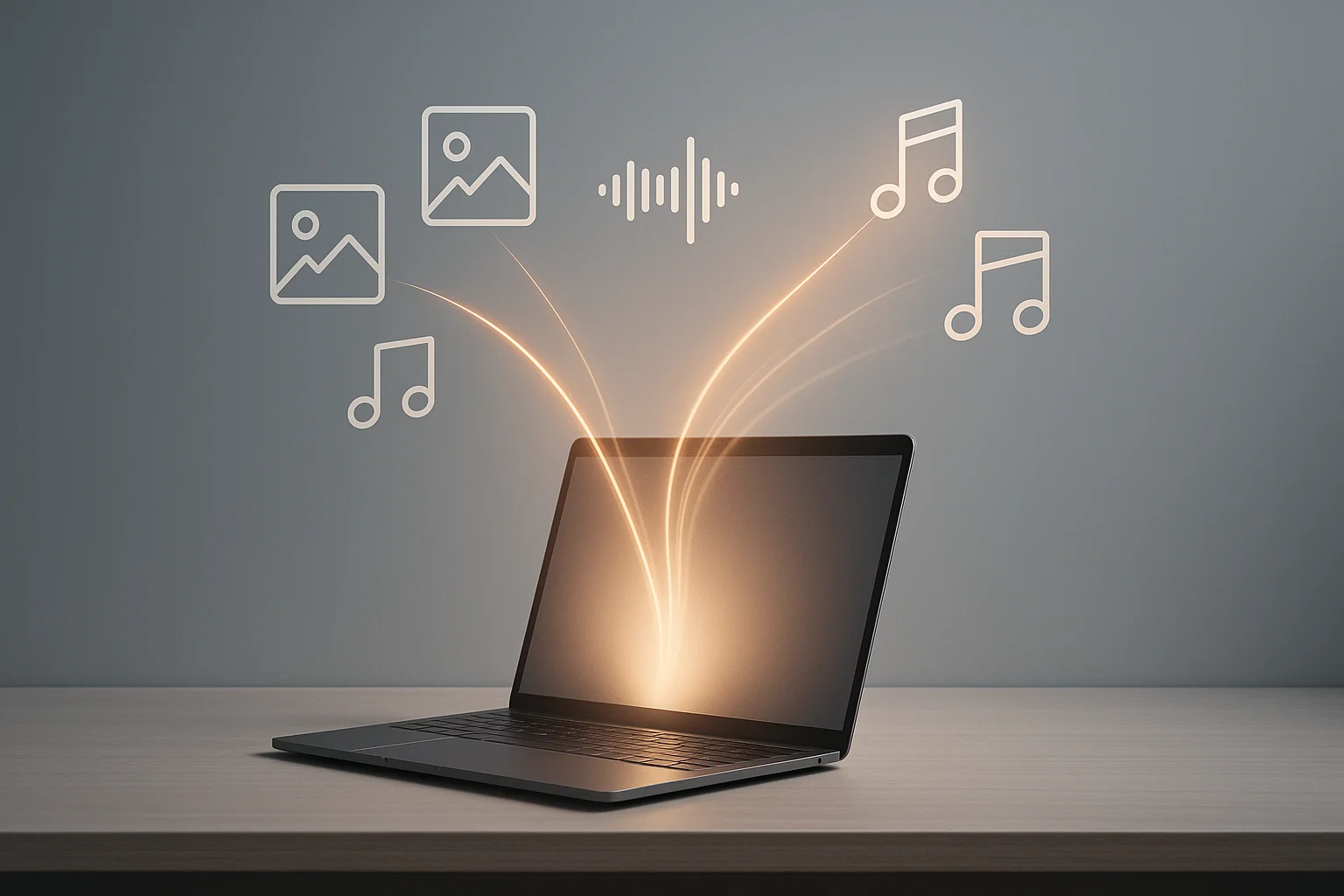
Google DeepMind introduced Gemma 4 12B on June 3, 2026, an open-weight multimodal model designed to run locally on laptops. The official announcement says it fits in 16GB of VRAM or unified memory, accepts text, images and audio, and reduces memory footprint by removing separate multimodal encoders. “Fits” is a compatibility claim. It does not mean that every laptop advertising that amount will deliver the same speed, context or quality.
The name contains two different facts. “12B” identifies a dense model of roughly twelve billion parameters. “Gemma 4” places it in a family that also contains edge-device variants, a mixture-of-experts model with 26B total parameters and a dense 31B model. The official family model card lists an Apache 2.0 license, pretrained and instruction-tuned weights, and context windows of up to 256,000 tokens for medium-size models.
What “encoder-free” actually means
A multimodal system must turn an image or audio waveform into representations a transformer can process. Many models give that translation to a specialized encoder and then pass its vectors to the language model. Gemma 4 12B avoids those separate modules, but it does not feed pixels or sound into the model without any transformation.
Google says vision uses a lightweight module with a matrix multiplication, positional information and normalization, while audio is projected into the same dimensional space as text tokens. The Gemma 4 technical report specifies that image patches and 40-millisecond audio chunks are projected into the embedding space. Precision matters: “encoder-free” describes a unified architecture, not an absence of preprocessing.
The intended advantage is to reduce fragmentation and additional memory while allowing the model core to learn relationships across modalities. The potential cost is that a unified design must demonstrate quality on tasks where a dedicated encoder benefited from modality-specific optimization. Architecture describes how information moves; it does not decide by itself whether a transcript, chart or photograph will be interpreted correctly.
Sixteen gigabytes is a starting point, not a guarantee
Google's figure specifies VRAM or unified memory. In a system with a discrete GPU, system memory and VRAM are separate pools. In a unified-memory machine, the operating system, applications and model share the same pool. The checkpoint, numeric precision, attention cache, context length and visual or audio resources also consume memory.
Two computers advertising 16GB can therefore behave differently. One may load the model and run out of headroom with a longer context. Another may offload computation to the CPU. A third may close processes or slow under memory pressure. “The model starts” is not the same as “the task finishes at a useful speed.”
The supported claim is narrower: Google designed the model for a class of consumer hardware and published a reference memory configuration. Users still need to identify the exact checkpoint, runtime, quantization or precision, and tested context. Without those four facts, a laptop demonstration is not reproducible.
A local testing protocol
First, record the machine: processor, GPU, RAM, VRAM or unified memory, operating system and free storage. Then record the exact artifact. Google's official Hugging Face repository distinguishes the base model and provides instructions for loading the checkpoint with Transformers. The identifier and revision matter because an update can change files, compatibility or behavior.
Second, fix the configuration: runtime and version, precision or quantization, maximum context length and reasoning mode. Two models are not being compared fairly when one receives more context, a different quantization or a larger generation budget. A failure caused by an incompatible library version should not be attributed to the model either.
Third, move in stages. Load the model and run a short text request. Then provide a small image with a known answer. Next, use a short audio clip with a reference transcript. Only then attempt the real task. At each stage, record peak memory, load time, time to first output, generation speed, errors and quality.
Fourth, inspect the data path. Local execution means inference can occur on the machine, but the application may download models, check for updates or send telemetry. For sensitive work, read the runtime documentation, observe network connections, work without remote services and verify that inputs and results remain in the intended folder.
How to read the comparison with the larger model
Google says 12B approaches its 26B MoE model on standard evaluations while using less than half the total memory footprint. That sentence contains two axes: benchmark outcome and memory. It does not say both models are interchangeable for every task or modality. The 26B model is a mixture of experts with 3.8B active parameters according to the report; total size alone does not describe computation for each step.
To move the comparison into a real use case, build an example set with known answers or verifiable criteria. For vision, include field extraction, chart reading and spatial relationships. For audio, include noise, proper names and speaker changes. For text, use one reasoning task and one strict-format task. Score accuracy, omissions, latency and human correction required.
Public averages help select candidates, not finalize a purchase or deployment. The model card collects results by evaluation and modality, but readers must inspect the metric, configuration and similarity to their own problem. “Near” gains meaning only after an acceptable margin is defined for a concrete task.
Local and open also need qualifications
Open weights allow an artifact to be downloaded, run and inspected in ways a closed API does not. Google's stated Apache 2.0 license supports modification and commercial use under its terms. That does not automatically make the training data, every runtime component or an application packaging the model open. An audit must separate weights, code, license, documentation and dependencies.
Local execution provides control over availability and data flow, but it transfers responsibilities. The operator manages updates, device security, temporary files, permissions and output evaluation. The operator also decides whether a tool call may change the system. A local model with broad access can cause local damage; removing the cloud does not remove the principle of least privilege.
What the unified architecture contributes
Gemma 4 12B matters because it changes the division of labor inside the model and brings three modalities closer to consumer hardware. The verifiable claim is that Google published weights, architecture, reference requirements and execution routes. Quality for a particular application remains an experimental question.
The transferable skill is turning “runs on your laptop” into a reproducible record: hardware, checkpoint, runtime, precision, context, memory, latency, quality and data flow. That record separates a successful load from a useful system and shows whether the encoder-free architecture improves the user's work, not just the vendor's demonstration.
The record should also preserve the date, model revision, configuration-file hashes and a sample of nonsensitive inputs and outputs. When the runtime or checkpoint changes, rerun the test set before comparing results. That prevents an apparent improvement from being confused with a version change and lets another person review the result.
This article was produced with artificial intelligence under human editorial oversight.