DeepMind Unveils Genie 3, AI-Generated Virtual Worlds
Google DeepMind has unveiled Genie 3, a model that generates navigable worlds at 24fps and 720p from text prompts, with consistent physics lasting several minutes. The company positions it as a key building block for training general-purpose agents.
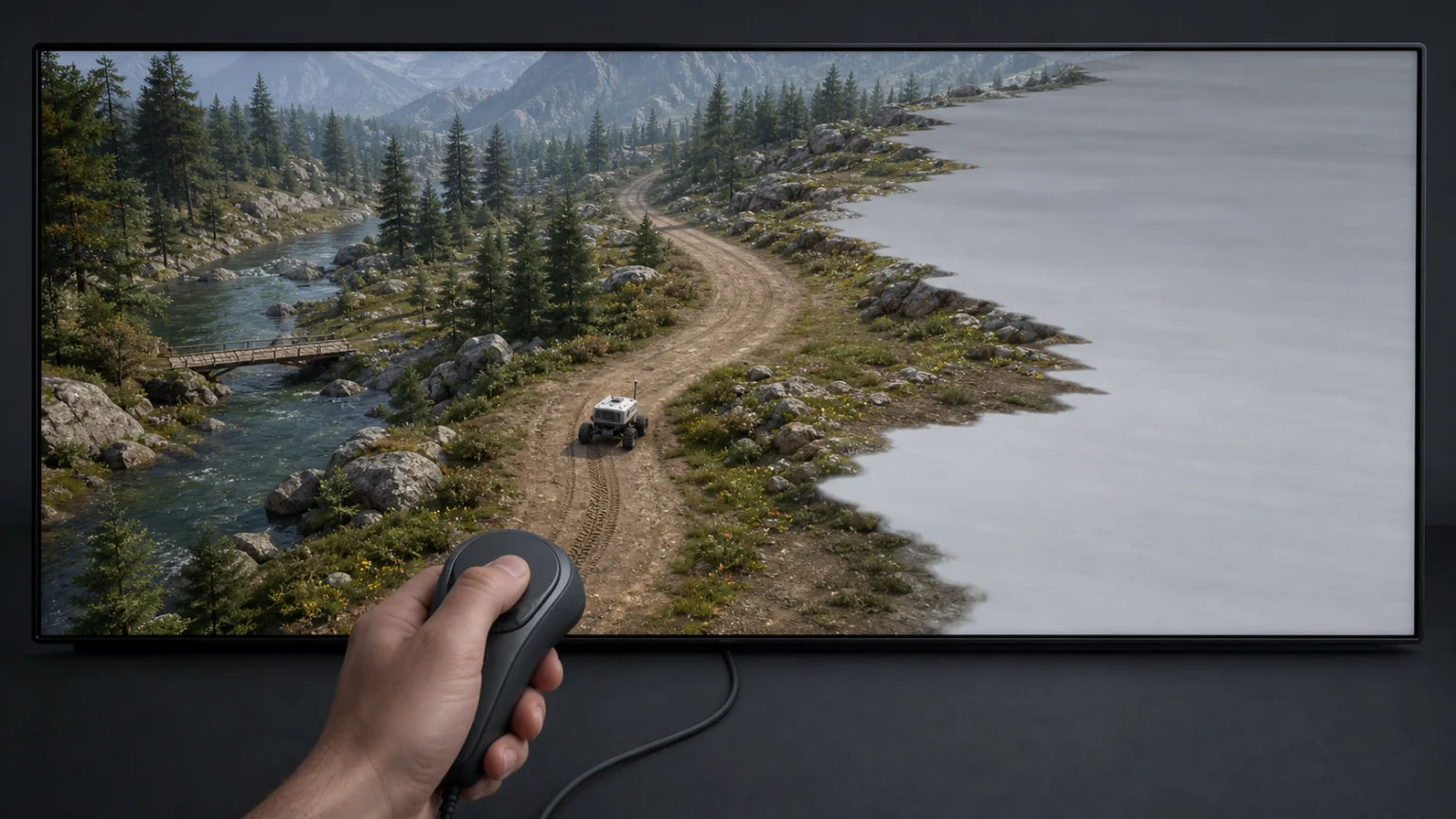
Google DeepMind has unveiled Genie 3, a model capable of generating navigable virtual worlds in real time from a simple text description. According to the company, the system produces environments at 24 frames per second and 720p resolution, maintaining visual consistency for several minutes of interaction.
What a world model is
A world model is an AI system trained to predict how an environment evolves as someone interacts with it: what happens if an object falls, if a character moves, or if the lighting in a scene changes. Rather than generating just a static image or video clip, these models build a space that responds to user actions moment by moment—like a video game generated on the fly instead of being pre-programmed.
Genie 3 pushes that idea to a point that hasn't been publicly demonstrated with this level of fluidity before: generating the environment and sustaining it coherently while someone explores it, rather than simply producing a short, predictable clip.
Why DeepMind is betting on this
DeepMind isn't presenting Genie 3 as a standalone entertainment tool, but as a building block for training general artificial intelligence agents. The logic goes like this: for an agent to learn how to act in the real world—moving around, manipulating objects, solving tasks—it needs to practice in varied, realistic environments. Building those environments by hand, one at a time, is slow and limited. If a model can generate new worlds on demand, that respond with sufficient stability, that same model becomes an infinite simulator for training and evaluating other AI systems.
This is why world models occupy a central place in the debate around AGI—artificial general intelligence capable of matching or surpassing human performance across a broad range of cognitive tasks. It's not just about generating pretty images: it's about giving agents a place to learn through trial and error without depending on data collected from the physical world, which is expensive and slow to gather.
What changes compared to generating video
The difference between generating a video and generating an interactive world is what sets Genie 3 apart from the video models we already know. A video model produces a closed sequence: it's defined in advance and doesn't respond to anything while it plays. A world model, by contrast, recalculates the environment at every instant based on what the person exploring it does, and it does so while attempting to preserve scene consistency and previously seen details for several minutes, according to DeepMind.
That persistence is the real technical challenge. It's relatively straightforward to generate a convincing image of a world; it's far harder for that world to still make sense thirty seconds later, once the user has turned the camera, moved an object, or retraced their steps.
What this means for the industry
If AI agents start training in worlds generated in real time instead of in manually programmed environments, the bottleneck for developing more capable systems shifts away from the scarcity of real-world data and toward the quality of the simulators that can be generated. That moves part of the AI competition toward who builds the best synthetic worlds to practice in, not just who trains the biggest models.
DeepMind hasn't detailed in its announcement when or how Genie 3 will become available to outside developers, but the presentation makes clear where the research is heading: world models are no longer a lab experiment—according to the company itself, they're becoming infrastructure for training the next generation of agents.
A demonstration is not yet a scientific simulator
The DeepMind announcement also lists limitations: the action space remains restricted, complex interactions among several agents are difficult, and real locations are not always reproduced accurately. Those limits correct an important confusion. Preserving visual consistency when revisiting an area does not mean the model has learned physical laws accurately enough to train a robot or validate a safety decision.
A useful simulator needs a measurable relationship between action and consequence. If an agent pushes an object, evaluators must know whether the response matches a reference and within which tolerance. A scene that looks convincing to a person can contain small errors in geometry, causality or permanence that a video hides but an agent exploits across thousands of episodes. The more synthetic the training, the more important it is to test the learned behaviour outside the generator.
Four questions for evaluating a world model
The first is horizon: how long relevant information survives and what happens when a user retraces a route. The second is controllability: which actions are available and whether they produce distinguishable outcomes. The third is fidelity: which regularities—objects, camera, causality or physics—are measured and against which dataset. The fourth is transfer: whether an agent trained inside improves in an independent environment or merely learns shortcuts in the generator.
Speed must also be separated from capability. The 24 frames per second and 720p figures describe an interactive experience in DeepMind’s demonstration. They do not reveal cost per minute, hardware, concurrent users or the diversity needed for a training curriculum. Without those units, fluidity is a visible property, not an estimate of viability.
The lack of general access at announcement time limits auditing. External evaluators need to repeat prompts, record actions, force returns to earlier locations and compare runs. They should also inspect representation: which regions, homes, bodies, signs or environmental conditions appear less faithfully, and which behaviours an agent learns from those absences.
There is also a difference between generating a curriculum and showing that the curriculum is useful. Apparent variety may repeat the same assumptions under different scenery. A laboratory should publish how worlds are selected, which skills they are meant to induce, which cases are held out for evaluation and whether the agent improves over one trained in programmed simulators. Without that comparison, “unlimited” describes scene production rather than the educational diversity inside it.
The skill that remains after the spectacle
A world model can be valuable as a generator of variety, test bed or creative interface without being a reliable copy of the world. The transferable skill is to separate four properties that a demonstration tends to blend: appearance, persistence, control and validity for training. Only the last requires evidence that learning survives outside the images that produced it. That test should use an environment the generator does not control and criteria chosen before observing the result, with external and independent evaluation.
This article was produced with artificial intelligence under human editorial oversight.