Inkling Opens Its Weights: What Downloading Thinking Machines’ Model Really Lets You Do
Thinking Machines Lab released Inkling on July 15 with weights available under Apache 2.0. Open weights create real options for adaptation, but do not turn a model of this scale into laptop software.
On July 15, 2026, Thinking Machines Lab released Inkling, its first model with available weights, and framed it as a base that others can adapt. The news looks simple to summarize: Mira Murati’s company has “opened” its AI. Yet that phrase compresses four different permissions and capabilities. Downloading weights is one thing; running them is another; modifying them is another; redistributing the result or using it in a product is another again.
The useful skill in this announcement is to separate those four questions. It applies to Inkling and to the next model marketed as open. It avoids automatic enthusiasm —“everyone will have the model on their computer”— as well as the opposite conclusion —“if it does not fit on my laptop, it is not really open.” Both miss important information.
First step: what Thinking Machines released
In its original announcement, Thinking Machines describes Inkling as a mixture-of-experts, or MoE, transformer: it has 975 billion total parameters and activates 41 billion for each token. It accepts text, images and audio as input and generates text. The company is also sharing a preview of Inkling-Small and makes the model available through Tinker, its fine-tuning platform.
The decisive phrase is “available weights.” Weights are the learned numerical values that shape a neural network’s responses. Having them lets an organisation keep a copy, inspect how the model is packaged, choose the infrastructure on which it is served and, within licence terms, make a version tuned for a specific task. That differs from receiving an API key: with an API, another company retains the model and controls infrastructure, version and price; with weights, a developer gains more technical control.
The release does not say Inkling is the strongest general model available. It explicitly says it is not. Its proposition is a different combination: input modalities, controllable reasoning effort and customisation. That qualification matters. “Open” primarily describes distribution; it is not a certificate that a model is better, safe for every use or cheap to operate.
Second step: four verbs that should not be blurred
Download. The official model card confirms that the weights are available and that the licence is Apache 2.0. Downloading means the model files can reach infrastructure the user controls. That matters for research, service continuity and experiments that do not want to depend on a single API. It does not yet mean the files will run on the device from which they were downloaded.
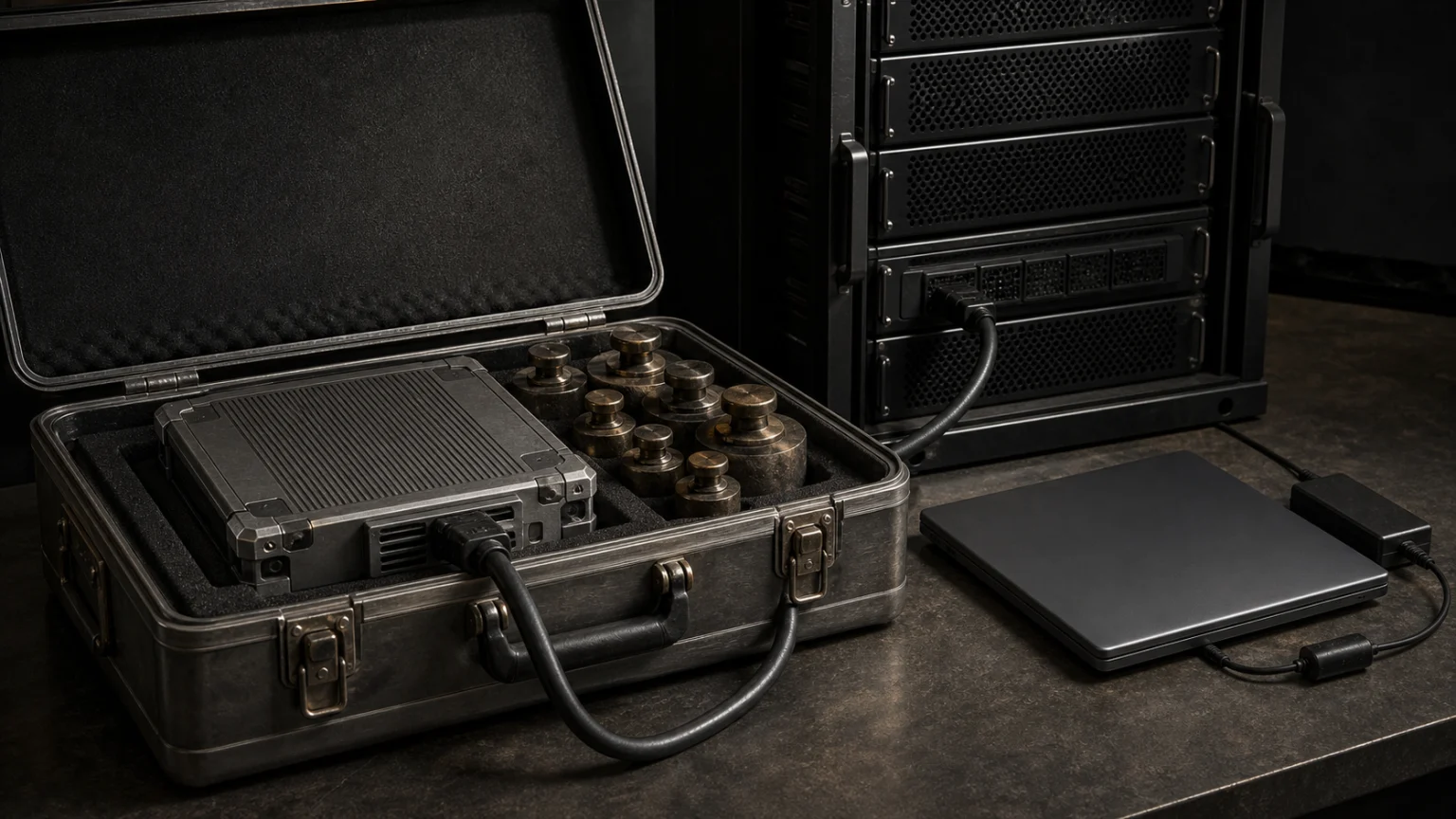
Run. This is where the physical limit missing from many headlines appears. The same card says the BF16 checkpoint needs at least 2 TB of aggregate video memory; it gives examples such as eight NVIDIA B300 GPUs or sixteen H200 GPUs. The quantised NVFP4 format lowers that requirement to at least 600 GB in aggregate. These are server or cluster configurations, not an ordinary home computer. So “running it locally” can mean running it on an organisation’s own university or company infrastructure, not on an offline laptop.
That precision does not reduce the value of open weights. It changes who can make direct use of them. A lab with GPUs, a company already operating inference, or a cloud provider can choose how and where to serve Inkling. A small team can use a compatible provider or a tuning platform. Practical access is a continuum: there is more than “it is on my PC” and “I fully depend on an API.”
Modify. Open weights make fine-tuning possible: training a later version on examples and evaluations from a particular domain without rebuilding the model from scratch. Thinking Machines links Inkling to Tinker and says it wants to make that customisation easier. Modification does not make a model infallible, nor does it happen by writing an instruction in a chat box. It requires data, training objectives, quality tests and a way to roll back if the specialised version makes previously good answers worse.
The useful example is not “AI for everything” but a bounded task: an assistant that classifies internal documentation, helps review a particular kind of code, or answers in a team’s vocabulary. Before tuning a model, an adopter should answer: which behaviour are we trying to change? Which cases will show that it improved? What information must not enter the training set? Opening weights supplies a lever; it does not settle those decisions.
Redistribute and use. Apache 2.0 is a permissive licence — it allows commercial use, modification and redistribution without asking permission — but it is worth reading its actual terms rather than the press release that mentions it. The licence text does not grant permission to use Thinking Machines’ name, trademark or logo when distributing a derivative; it requires keeping copyright notices intact and explicitly marking which files were changed; and it provides the software "as is," with no warranty of any kind. It also has a clause rarely read: if a user sues Thinking Machines for patent infringement related to Inkling, they automatically lose the patent licence Apache 2.0 granted them. On that point, the licence leaves no room for interpretation.
On top of the software licence, Thinking Machines publishes an acceptable-use policy that does impose content and usage restrictions — from not generating material that facilitates mass-casualty weapons to not impersonating real people or circumventing the model’s own safety measures — applicable to model materials and modified versions alike. Apache 2.0 opens the technical and legal door to redistributing and modifying; the acceptable-use policy is what actually limits what for. Neither one exempts a deployment from everything else: privacy, security, intellectual-property and sector-specific rules still apply exactly as they would if the model were not open.
What people who didn’t sell it say
None of the above requires taking Thinking Machines’ word for it. Artificial Analysis, which measures every model with the same protocol, places Inkling at 41 points on its Intelligence Index — 10th out of 97, well above the median of 25 among open-weight models of comparable size. That is a figure a reader can compare directly against any other model on the same table, without depending on which benchmarks a lab chose to showcase.
Sebastian Raschka, an independent researcher with no lab affiliation, compared Inkling’s published numbers against GLM-5.2 the day after launch: Inkling leads on instruction-following (79.8% versus 73.3% on IFBench) and factual accuracy (43.9% versus 38.1% on SimpleQA Verified), but trails on expert reasoning without tools (29.7% versus 40.1% on Humanity’s Last Exam), real-world code fixes (54.3% versus 62.1% on SWE-Bench Pro), and, by a wide margin, agentic terminal tasks (63.8% versus 82.7% on Terminal-Bench 2.1). Raschka himself warns against over-reading small differences in freshly published numbers, and describes Inkling as "a solid all-rounder" built for specialised fine-tuning rather than a model designed to top leaderboards.
The picture that emerges is neither the "best open model" headline nor its opposite: a model strong at some tasks, behind at others, evaluated by someone with no stake in the number looking good.
A test that prevents a misleading headline
For the next announcement, ask four questions in order. First: what is actually being delivered —weights, code, an API or only a demo? Second: under which licence and usage policy? Third: which hardware and software are needed to run the released checkpoint? Fourth: what practical route will a reader or organisation have —download it, buy inference, tune it through a platform, or build on an API?
The answers can be mixed. Inkling, for instance, offers weights while also providing a route for use and fine-tuning in Tinker; the platform documentation lists 64,000- and 256,000-token context options for the service. That is not a contradiction. It is the difference between a capability existing and it being convenient, affordable or accessible to every person.
It is also worth asking for evidence that openness is operational: download links, a model card, licence, checkpoint formats and inference-engine compatibility. A slogan about “democratising” does not answer these questions. In Inkling’s case, the company lists formats and VRAM requirements and names inference tools; those details make it possible to assess scope without turning a commercial promise into a universal fact.
What remains true in a year
The pattern will outlast the names of today’s labs. Future models will be smaller, larger, more quantised or offered through hybrid access. The word “open” remains useful only when it has an object: open what, for whom, under which rules, and at what running cost?
Inkling does expand choice for people with infrastructure or access to providers: they can study, tune and deploy a checkpoint instead of being limited to requests sent to a remote black box. It does not promise that every person can operate 975 billion parameters at home. Holding both ideas together is the right way to read the news. Openness is not a switch; it is a set of controls worth naming before celebrating or dismissing a release.
Sources: Inkling announcement, model card, acceptable-use policy, Tinker documentation, Apache 2.0 licence, Artificial Analysis and Sebastian Raschka.
Sources for this piece
This piece draws on 4 primary source(s), gathered during reporting.
This article was produced with artificial intelligence under human editorial oversight.