Meta unveils V-JEPA, a model that learns from video without pixels
Meta unveiled V-JEPA on 15 February 2024. The model does receive pixels, but does not learn by reconstructing them: it predicts representations of masked regions. Objective, representation and protocol separate recognition from a world model.
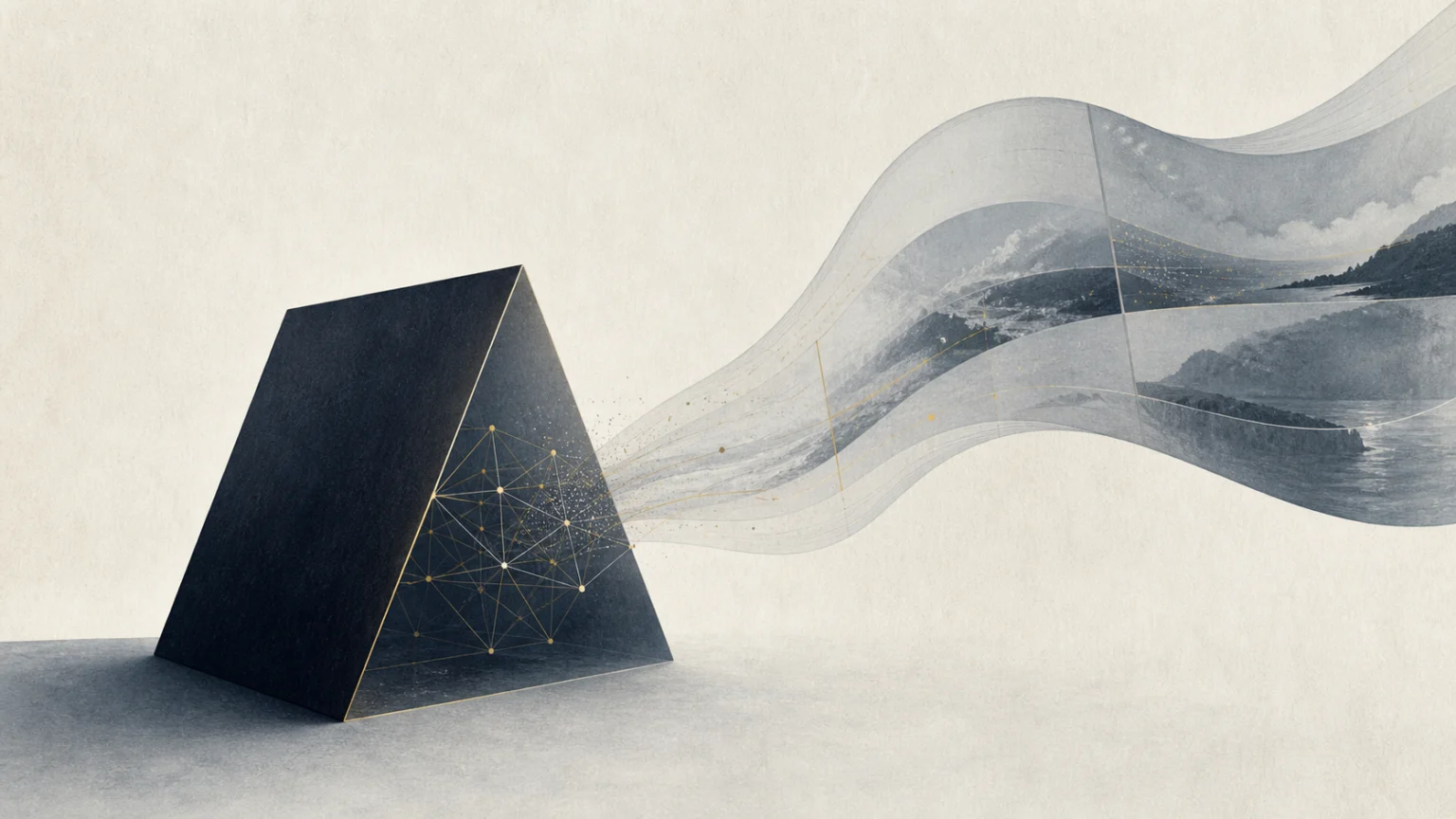
Meta unveiled V-JEPA on Thursday, 15 February 2024, a vision model trained on video without human annotations. The headline needs one qualification: V-JEPA does receive pixels as input, but it does not try to reconstruct the pixels masked during training. It predicts their representation in a learned mathematical space.
The difference lies in the objective. A reconstruction model must recover colour, texture and other details of the hidden region. V-JEPA can discard hard-to-predict variations and retain features useful for recognising objects and motion. Meta's announcement described it as research towards internal world models, not a video generator or consumer product.
The durable skill is to separate four parts of any learning system: what data it observes, what objective it optimises, what representation it produces and how it is evaluated. Saying that a model “learns from video” without those four answers does not reveal what it learned.
Pixel input, representation target
V-JEPA stands for Video Joint-Embedding Predictive Architecture. During pretraining, a context encoder processes the visible parts of a clip. A second encoder produces target representations of regions masked across space and time. A predictor tries to approximate those targets using only the available context.
The training loss compares vectors, not images. Those vectors—also called embeddings or features—place video information in a space where certain similarities and differences may prove useful. They do not arrive with human labels such as “lifting a cup”; their meaning emerges from the objective and data.
Masking large regions is essential. If isolated pixels are hidden, the model may solve the task by copying neighbouring detail. If a mask exists at only one instant, it can inspect the frame immediately before or after. Meta used spatio-temporal masks that remove blocks across several moments, demanding a less trivial prediction.
“Abstract” does not mean that the vector contains clean human concepts. An embedding may mix appearance, position, movement and dataset biases. Discovering what it preserves requires controlled tasks, alternative comparisons and failure analysis. The representation is not a readable explanation by itself.
Why not reconstruct every detail
A visual future has many possible continuations. Leaves can move in different ways without changing the presence of a tree; a person can shift slightly without changing the fact that they pick up an object. Requiring one exact image penalises plausible alternatives and spends capacity on detail that may not matter downstream.
Feature prediction lets the system ignore some of that uncertainty. Instead of choosing the precise colour of a hidden shirt, it may retain the presence of a person, posture and the changing position of an object. The objective does not guarantee those factors will be learned, but creates room to prioritise them.
This does not make pixel generation useless. If the final task is video restoration, scene synthesis or texture editing, detail matters. If it is action classification or temporal localisation, a compact representation may fit better. Architecture should be judged against the use, not a universal ranking of “generation” and “understanding.”
What self-supervised means
The V-JEPA paper describes pretraining on two million videos gathered from public datasets, without text, human labels, negative examples, a pretrained image encoder or pixel reconstruction. “Self-supervised” means that the supervisory task is constructed from the data itself: show one part and turn another into the target.
It does not mean that no human decisions exist. People selected collections, filters, architecture, mask, clip length, loss and metrics. Nor does it mean every public video is free of rights, bias or sensitive content. Removing labels reduces annotation cost; it does not remove data governance.
Labels enter later, when the encoder is adapted or evaluated. To learn whether its representation distinguishes actions, a small head is trained with labelled examples. Readers should therefore ask where each dataset appears: pretraining, adaptation, hyperparameter selection or testing.
Frozen evaluation measures transfer
A central test uses a frozen backbone. After pretraining, the large encoder weights do not change; only a small probe or head is trained for the task. If that probe performs well, the necessary information was already accessible in the representation.
The official V-JEPA code and model repository publishes configurations and checkpoints. Its higher-resolution ViT-H/16 reached 81.9% on Kinetics-400 and 72.2% on Something-Something-v2 with attentive probes, according to the project tables. The two benchmarks measure different axes: the first may reward appearance cues, while the second requires finer distinctions in motion and temporal order.
A classification score does not demonstrate general physical understanding. The system selects among defined categories within a data distribution. It is not asked to explain why an object falls, plan an intervention or act safely in a novel situation. The result supports a narrower claim: the features transferred well to those tasks under that protocol.
Resources must also be compared. Meta reported training- and sample-efficiency gains over pixel-reconstruction methods. To interpret a multiplier, preserve architecture, samples seen, schedule, resolution, total cost and baseline. “Six times more efficient” without that table cannot be transferred to another workload.
From perception to a world model
Yann LeCun presents JEPA as a route towards systems that form internal models of their environment. A world model in the strong sense should represent states, anticipate their evolution and support decisions or plans. The 2024 V-JEPA mainly covered perception in short clips—seconds long and up to roughly ten seconds, according to Meta.
The word “world” can inflate the claim. Predicting latent regions in recorded video tests a form of spatio-temporal regularity; it does not establish causal understanding, robust object permanence, long-horizon planning or interaction. Video also lacks the action a system could choose and the consequence of choosing it.
Moving from observation to control would require, among other things, action-conditioned predictions, memory, goals, uncertainty and out-of-distribution testing. A robot needs to know not only what usually follows, but what it can cause, what it does not know and when it should stop.
How to audit the next understanding claim
The minimum record begins with input and horizon: frames, audio, text, actions and duration. Then comes the objective: pixels, tokens, features, reward or next observation. Next record data and licence, architecture, updated parameters and test protocol. Finally copy the precise claim and the limitation acknowledged by the authors.
A persuasive evaluation should include relevant baselines, frozen evaluation and full fine-tuning where appropriate, resource-matched comparisons, ablations and failures. A world-model claim additionally needs future prediction, uncertainty, environmental change and planning or control—not classification alone.
V-JEPA contributes a valuable idea: learning a useful representation does not always require reconstructing everything observable. Its measured achievement was to produce versatile features through self-supervised latent prediction. Keeping input, objective, representation and evaluation separate allows readers to value that advance without prematurely turning it into a machine that understands the world like a person.
Open research is not the same as an open product
Meta released code, configurations and checkpoints under research-oriented terms and described the model as licensed under Creative Commons NonCommercial. That permits inspection and extension, but does not automatically authorise incorporation into a paid service. Technical reproducibility and exploitation rights are separate axes: adopters must read both the repository and the applicable licence.
This article was produced with artificial intelligence under human editorial oversight.